9 CHAPTER 8: TERRORISM AND NERT
In this chapter you will learn about:
- What Terrorism Is: The definition of terrorism and terrorist goals.
- Terrorist Targets: How terrorists choose their targets.
- Terrorist Weapons: The weapons that terrorists are known or are suspected to have, and the risk posed by various terrorist weapons.
- CBRNE Indicators: Cues that help to identify a when terrorist attack may have occurred or may be imminent.
- Preparing at Home, Work, and in Your Neighborhood: Ways to prepare for a terrorist incident.
- NERTs and Terrorist Incidents: NERT protocols for terrorist incidents and protective action following an event.
9.1 Introduction and Chapter 8 Overview
9.1.1 CHAPTER 8 OBJECTIVES
At the end of this unit, you should be able to:
- Define terrorism.
- Identify potential targets in the community.
- Identify the eight signs of terrorism.
- Identify NERT operating procedures for a terrorist incident.
- Describe the actions to take following a suspected terrorist incident.
9.1.2 CHAPTER 8 TOPICS
This unit will cover the following topics:
- What Is Terrorism?
- Terrorist Targets
- Terrorist Weapons
- CBRNE Indicators
- Preparing at Home, Work, and in Your Neighborhood
- NERTs and Terrorist Incidents
9.2 What Is Terrorism?
The U.S. Department of Justice’s definition of terrorism:
- The unlawful use of force or violence against persons or property to intimidate or coerce a government, the civilian population, or any segment thereof, in furtherance of political or social objectives.
- Terrorism may be perpetrated by foreign or domestic individuals or groups. While the United States has not had as many terrorist incidents as some other countries, we have had several serious attacks, including:
- The bombing of the World Trade Center (1993)
- The bombing of the Alfred P. Murrah Federal Building in Oklahoma City (1995)
- The bombing at the Atlanta Olympic Games (1996)
- Bombings at family planning clinics and gay bars in the Atlanta area (1996 and 1997)
- The destruction of the World Trade Center and a portion of the Pentagon (2001)
- The sending of anthrax through the U.S. mail (2001)
Each of these incidents demonstrates that we live with the possibility of additional terrorist attacks on our own soil.
9.2.1 TERRORIST GOALS
Terrorist attacks can occur with or without warning. Because of the nature of terrorist attacks, they can, and are often intended to, result in:
- Mass casualties
- Loss of critical resources
- Disruption of vital services
- Disruption of the economy
- Heightened fear
9.3 Terrorist Targets
Terrorists choose their targets to meet specific goals. For example, the Oklahoma City bombing was a strike against the Federal Government. The September 11, 2001, attacks targeted both our economic center and our military establishment while raising casualty levels to new heights and changing the way Americans think about their safety.
Terrorists may select “soft” or lightly protected targets over “hard” or very secure targets.
Potential terrorist targets might include:
- Seats of government
- Key industries
- Bridges, subways, tunnels, and other key transportation facilities
- Water supplies and utilities
- Places of historical significance
Terrorists may also be drawn to major events such as parades or athletic and entertainment events. Because of this, you may see increased security measures to help deter and prevent terrorism.
9.4 Terrorist Weapons
CBRNE
Experts generally agree that there are five categories of possible terrorist weapons. The acronym CBRNE will help you remember the five categories.
- Chemical
- Biological
- Radiological
- Nuclear
- Explosives
While this unit focuses on terrorism, it is important to remember that CBRNE incidents may occur accidentally (such as a chlorine tanker truck accident) or naturally (such as pandemic influenza).
Recently, terrorist attacks have trended away from large resource intensive plots such as the September 11 attacks to more decentralized, less sophisticated attacks like those in Paris, France in 2016. Attackers have favored smaller, less centrally controlled networks, using more simplistic and accessible means such as guns and homemade improvised explosive devices (IEDs). These components are easier to acquire, control, and conceal than large high-yield explosives, biological, radiological, or nuclear devices. Although there is always some risk from CBRNE type incidents and the United States remains vigilant against these threats, it is difficult to obtain and deploy these types of weapons.
Active Shooter
An Active Shooter is an individual actively engaged in killing or attempting to kill people in a confined and populated area. In most cases, active shooters use firearms(s) and there is no pattern or method to their selection of targets. Active shooter situations are unpredictable and evolve quickly. Typically, the immediate deployment of law enforcement is required to stop the shooting and mitigate harm to survivors.
Many recent terrorist attacks have included armed individuals with some training indiscriminately shooting civilians; although the motivations are different than a single active shooter, the results are similar: rapidly accumulating casualties in a contained space.
Improvised Explosive Devices (IED)
An IED attack is the use of a “homemade” bomb and/or destructive device to destroy, incapacitate, harass, or distract. Because they are improvised, IEDs can come in many forms, ranging from a small pipe bomb to a sophisticated device capable of causing massive damage and loss of life.
Terrorist networks both domestic and abroad have published numerous sets of instructions on how to make homemade explosives. IEDs consist of a variety of components that include an initiator, switch, main charge, power source, and a container. IEDs can be worn (belts, vests), carried (bags, backpacks, containers of all sizes/types), or transported in a vehicle; placed or thrown by a person; delivered in a package; or concealed on the roadside.
To gain a better understanding of the impact that IEDs can have, the table below illustrates the damage radius caused by various sizes and types of IEDs.
Image 8.1: IED Impact
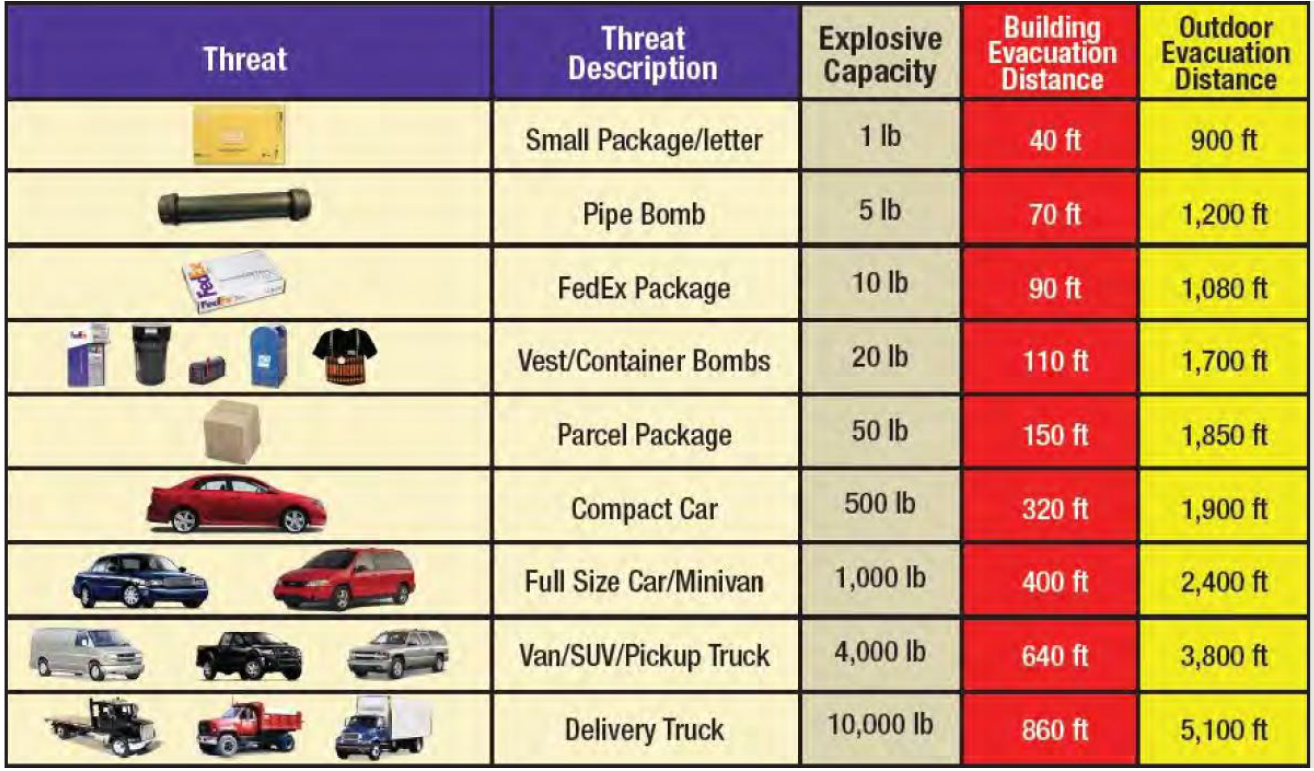
IEDs may be surrounded by or packed with additional materials or “enhancements” such as nails, glass, or metal fragments designed to increase the amount of shrapnel propelled by the explosion to maximize casualties. Enhancements may also include other elements such as hazardous materials. An IED can be initiated by a variety of methods depending on the intended target.
Complex Coordinated Terrorist Attacks
A complex coordinated terrorist attack is a synchronized attack, conducted by two or more semi-independent teams at multiple locations in close succession, initiated with little or no warning, using well trained attackers and employing one or more of the following: firearms, explosives, and fire as a weapon.
As seen in Paris, France in 2016, attackers have coordinated their actions to hit multiple targets nearly simultaneously. When conducting these attacks, there may be pre-planned coordination as well as real-time coordination between attackers. These attacks can be extremely lethal in a relatively short period of time.
Cyber Attacks
Another type of terrorist weapon is deliberate, large-scale disruption of computer networks. This is known as cyberterrorism. To help guard against cyber terrorism, it is important that computer users implement appropriate security measures.
Cybersecurity involves protecting infrastructure by preventing, detecting, and responding to cyber incidents. Unlike physical threats that prompt immediate action—like stop, drop, and roll in the event of a fire—cyber threats are often difficult to identify and comprehend. Among these dangers are viruses erasing entire systems, intruders breaking into systems and altering files, intruders using your computer or device to attack others, or intruders stealing confidential information. The spectrum of cyber risks is limitless. Threats, some more serious and sophisticated than others, can have wide-ranging effects at the individual, community, organizational, and national levels.
- Organized cybercrime, state-sponsored hackers, and cyber espionage can pose national security risks to our country.
- Transportation, power, and other services may be disrupted by large-scale cyber incidents. The extent of the disruption will be determined by many factors such as the target and size of the incident.
- Vulnerability to data breach and loss increases if an organization’s network is compromised. Information about a company, its employees, and its customers can be at risk.
- Individually-owned devices such as computers, tablets, mobile phones, and gaming systems that connect to the Internet are vulnerable to intrusion. Personal information may be at risk without proper security.
9.4.1 ASSESSING THE RISK
- Although nuclear weapons present the highest impact, they are considered the lowest risk because of the difficulty in obtaining enough weapons-grade material and the technical complexity of developing and maintaining the tolerances required for a nuclear device to detonate.
- Chemical and high-yield explosive devices are considered higher risk but lower impact weapons.
- Biological weapons are considered both high-risk and high-impact weapons — but only for diseases that are highly contagious. Other types of biological weapons (i.e., those requiring dispersal devices) are considered a lower risk because of the sensitivity of the biological agents to heat, light, and shock.
ASSESSING THE RISK (CONTINUED)
9.5 Eight Signs of Terrorism
We all have a responsibility to play an active role in keeping the country safe. Everyone should report to authorities anything they see that seems suspicious or out of place. The phrase “If you see something, say something” took on additional power after the foiled Times Square bomb plot in New York City. On May 1, 2010, street vendors in Times Square noticed a smoking SUV with its blinkers on, engine running, and no one inside. They decided to say something to a police officer. Thousands of people were cleared from the area while the bomb was dismantled.
Through funding from DHS, the Center for Empowered Learning and Living (the CELL) produced a video outlining the eight warning signs that terrorist activity may be forthcoming (www.thecell.org). These signs are exhibited by potential terrorists (often in this order) and include:
- Surveillance: The targeted area is watched and studied carefully. This may include recording or monitoring activities.
- Elicitation: Information is gathered that is specific to the intended target. This may be by mail, phone, or in person.
- Tests of security: Local security measures are tested and analyzed, including measuring reaction times to security breaches or attempts to penetrate security.
- Funding: Raising, transferring, spending money, which may include selling drugs or stolen merchandise, funneling money through businesses or charities
- Acquiring supplies: Necessary supplies are gathered to prepare the attack, including weapons/weapon components, transportation, and communications. Supplies may be purchased with cash only.
- Impersonation or suspicious people who don’t belong: People impersonating roles to gain access or information and people who don’t fit in or don’t seem to belong in the location
- Rehearsal and dry runs: Groups or individuals will often operate test runs before the actual attack.
- Deployment: The final and most urgent phase when terrorists are deploying assets and getting into position. Attack is imminent.
The presence of even a few of these signs may indicate the possibility of a terrorist attack.
Although it is not the mission of NERT members to keep constant watch for these eight signs, everyone should be alert to changes in their environment as a clue to a possible terrorist attack and report suspicious activities to appropriate authorities.
9.6 CBRNE Indicators
9.6.1 INDICATORS AN ATTACK HAS OCCURRED OR IS UNDERWAY
While bombs and explosions have obvious immediate effects, biological or chemical attacks may not be as immediately noticeable. Indicators that a biological or chemical attack has occurred or is underway could include:
- Vapor clouds or mists that are unusual for the area or for the time of day. Although many biological and chemical agents cannot be seen with the naked eye, the substances in which they are suspended when dispersed may be visible for a period of time after an attack.
- Unusual odors or tastes
- Out of place and unattended packages, boxes, or vehicles. Items that are out of place and unattended could signal a possible terrorist attack. This could include chemical or biological agents as well as explosives.
- Packages that are leaking may be harmless, but they may also signal a terrorist incident. The terrorists who released sarin in the Tokyo subway system (Aum Shinrikyo) merely poked holes in bags containing sarin, then left the area as the poison leaked out.
CBRNE INDICATORS (CONTINUED)
If you observe any of these indicators of a terrorist incident, you should:
- Do Not Touch It!
- Move away from the object or area
- Report it to authorities immediately
Remember: Cellular phones and two-way radios create static electricity and may detonate explosive devices. NERT members should always report suspected explosive devices.
Physical effects on people and animals may also indicate that a chemical or biological attack has occurred. These may include:
- Numerous sick or dead animals, fish, or birds. Wildlife is often more sensitive to chemical or biological agents than humans. The absence of wildlife or insects that are common for the area or animals, fish, or birds that are obviously sick, dying, or dead may indicate the presence of a biological or chemical attack.
- Large numbers of persons seeking medical attention with similar symptoms that are not characteristic of the season. The symptoms of many biological agents mimic the flu or other common illnesses. An unusually large number of persons seeking medical attention for the flu in July could indicate that a biological attack has taken place.
- Multiple survivors who are exhibiting similar symptoms. Symptoms may range from difficulty breathing to skin necrosis to uncontrolled salivating, uncontrolled muscle twitching, convulsions, or seizure activity. All of these symptoms indicate that a chemical attack may have taken place.
- Multiple casualties without obvious signs of trauma may indicate a biological or chemical attack.
9.7 Preparing at Home, Work, and In Your Neighborhood
Because personal safety is the first priority, as with hazardous materials, NERT members should treat possible terrorist incidents as a stop sign. NERTs are not equipped or trained to respond to terrorist incidents. Professional responders will need specialized equipment and personnel to respond to a terrorist incident.
In addition, it is important to remember that terrorism incident scenes are also crime scenes. NERT members should avoid taking any action that may disturb potential evidence.
9.7.1 PREPARE FOR TERRORIST ACTIVITY
There are ways to prepare for a terrorist incident. The CBRNE events covered in this unit are survivable and what you learn and do now may impact the quality of your survival. Many of the steps for preparing for a terrorist incident are the same as for natural hazards. Please review Chapter 1: Disaster Preparedness on the importance of learning about community alerts and warnings, having household plans, and assembling supplies in multiple locations. This chapter will focus on some of the preparedness actions and protective measures that are particularly relevant for CBRNE events. These include sheltering-in-place; understanding the concepts of time, distance, and shielding; and decontamination.
ACTIVE SHOOTER SITUATIONS
Active shooter situations are unpredictable and evolve quickly.
How to Respond When an Active Shooter is in Your Vicinity
Quickly determine the most reasonable way to protect your own life. Remember that customers and clients are likely to follow the lead of employees and managers during an active shooter situation.
- RUN
If there is an accessible escape path, attempt to evacuate the premises. Be sure to:
- Have an escape route and plan in mind ahead of time;
- Evacuate regardless of whether others agree to follow;
- Leave your belongings behind;
- Help others escape, if possible;
- Prevent individuals from entering an area where the active shooter may be, if possible;
- Keep your hands visible;
- Follow the instructions of any police officers; and
- Call 9-1-1 when you are safe.
- HIDE
If evacuation is not possible, find a place to hide where the active shooter is less likely to find you. Your hiding place should:
- Be out of the active shooter’s view;
- Provide protection if shots are fired in your direction (i.e., an office with a closed and locked door); and
- Not trap you or restrict your options for movement.
- To prevent an active shooter from entering your hiding place:
- Lock the door; and
- Blockade the door with heavy furniture.
- If the active shooter is nearby:
- Lock the door;
- Silence your cell phone and/or pager;
- Turn off any source of noise (e.g., radios, televisions);
- Hide behind large items (e.g., cabinets, desks); and
- Remain quiet.
- If evacuation and hiding out are not possible:
- Remain calm;
- Dial 9 -1-1, if possible, to alert police to the active shooter’s location; and
- If you cannot speak, leave the line open and allow the dispatcher to listen.
- FIGHT
If you are unable to run, evacuate or hide and when your life is in imminent danger, you may attempt to disrupt and/or incapacitate the active shooter by:
- Taking decisive action;
- Acting as aggressively as possible against him/her;
- Throwing items and improvising weapons;
- Yelling; and
- Committing to your actions.
How to Respond When Law Enforcement Arrives
Law enforcement’s purpose is to stop the active shooter as soon as possible. Officers will proceed directly to the shooting without stopping to render aid to the survivors.
- Officers may arrive in teams;
- Officers may wear street clothes, regular patrol uniforms, or external bulletproof vest, Kevlar helmets, and other tactical equipment;
- Officers may be armed with rifles, shotguns, and/or handguns; and
- Officers may shout commands and may push individuals to the ground for their safety.
How to react when law enforcement arrives: Try to remain calm;
- Follow officers’ instructions;
- Put down any items in your hands (e.g., bags, jackets);
- Immediately raise hands and spread fingers;
- Keep hands visible at all times;
- Avoid making quick movements toward officers such as holding on to them;
- Avoid pointing, screaming, and/or yelling; and
- Do not stop to ask officers for help or direction when evacuating, just proceed in the direction from which officers are entering the premises.
Information to provide to law enforcement or 9-1-1 operator:
- Location of the active shooter(s);
- Number of shooters, if more than one;
- Physical description of shooter(s);
- Number and type of weapons held by the shooter(s); and
- Number of potential targets at the location.
- The first officers to arrive to the scene will not stop to help injured persons. Expect rescue teams comprised of additional officers and emergency medical personnel to follow the initial officers. These rescue teams will treat and remove any injured persons. They may also call upon able-bodied individuals to assist in removing the wounded from the premises.
Once you have reached a safe location or an assembly point, you will likely be held in that area by law enforcement until the situation is under control, and all witnesses have
been identified and questioned. Do not leave until law enforcement authorities have instructed you to do so.
9.7.2 SHELTER-IN-PLACE PROCEDURES
Procedures for sheltering-in-place during a chemical or biological attack include:
- Shut off the ventilation system and latch all doors and windows to reduce airflow from the outside.
- Go to your shelter-in-place room (where your precut plastic, duct tape, radio, and other supplies should be stored).
- Use precut plastic sheeting to cover openings where air can enter the room, including doors, windows, vents, electrical outlets, and telephone outlets. When cut, the sheeting should extend several inches beyond the dimensions of the door or window to allow room to duct tape the sheeting to the walls and floor.
- Tape the plastic sheeting around all doors and windows using duct tape to ensure a good seal.
- Seal with duct tape other areas where air can come in, such as under doors and areas where pipes enter the home. Air can be blocked by placing towels or other soft objects in areas where air could enter, then securing them with duct tape.
- Listen to a battery-powered radio for the all-clear. Chemicals used in an attack will be carried on the wind and will dissipate over time. You will generally not need to stay in a sealed room for more than a few hours. Listen to Emergency Alert System broadcasts to know when it is safe to leave the safe room.
- After contaminants have cleared, open windows and vents and turn on fans to provide ventilation.
To be able to execute these procedures during an actual event requires that you:
- Store precut plastic sheeting in your identified shelter-in-place room
- Assemble and store food, water, and a battery-operated radio in the shelter-in-place room
- Practice sealing the room
- Establish shelter-in-place procedures wherever you spend significant amounts of time at home, at work, at school
As a rule of thumb, 10 square feet of floor space per person will provide sufficient air to prevent carbon dioxide buildup for up to 5 hours, assuming a normal breathing rate while resting.
9.8 NERTs and Terrorist Incidents
9.8.1 PROTECTION FROM RADIOACTIVE FALLOUT
There are three factors that significantly affect safety after an incident that involves radiation, such as a dirty bomb or a nuclear device. They are distance, shielding, and time. A critical protective action in a radiological or nuclear event is to get inside as quickly as possible, stay inside, and stay tuned to local radio or television stations for further guidance.
- Go Deep Inside (distance/shielding): It is important to find adequate shelter quickly to avoid radioactive fallout resulting from the explosion. Get inside as soon as possible and go to the farthest interior room or to a basement. Flat roofs collect fallout particles so the top floor is not a good choice, nor is a floor adjacent to a neighboring flat roof. The more distance between you and the fallout particles, the better.
If you are outside when the event occurs, do not look at the flash or fire ball. It can blind you. Take cover behind anything that will offer protection, lie flat, and cover your head. If the explosion is some distance away, it could take 30 seconds or more for the blast wave to hit. Get inside as soon as you can. If you are not able to get inside, maintain as great a distance as possible from the incident and shield yourself with any available resources: earth, concrete, bricks, books.
- Stay Inside (time): Limiting the amount of time in the area of an incident is important to limit exposure to avoid radioactive fallout resulting from the explosion.
Stay inside unless you are threatened by fire, building collapse, medical necessity, or other
immediate threats. Remain inside until you receive notification from authorities that it is safe to leave the building. Be prepared to shelter inside for up to 2 to 3 days.
- Stay Tuned: Radiation levels outside will gradually drop and authorities will tell you
when it is safe to go outside, bearing in mind that the explosion will have caused significant damage to buildings and infrastructure.
9.8.2 BASIC DECONTAMINATION PROCEDURES
The objective of decontamination is to remove harmful chemicals or particles of radioactive dirt or dust that have come in contact with the skin or clothes.
- Leave the contaminated area immediately. Depending on the circumstances, go inside, go outside, or go upwind, uphill, or upstream from the contaminant. (Seek a distance of at least 1,000 to 1,500 feet.)
- Take decontamination action. Seconds count! The goal is to limit the time that the agent is in contact with the skin.
- Remove everything from the body, including jewelry. Cut off clothing that would normally be removed over the head to reduce the probability of inhaling or ingesting the agent. Seal your clothes in a plastic bag.
- Wash hands before using them to shower. If no shower is available, improvise with water from faucets or bottled water.
NERTS AND TERRORIST INCIDENTS (CONTINUED)
- Flush the entire body, including the eyes, underarms, and groin area, with copious amounts of cool water. Hot water opens the pores of the skin and can promote absorption of the contaminant. Using copious amounts of water is important because some chemicals react to small amounts of water.
- If soap is immediately available, mix the soap with water for decontamination. Avoid scrubbing with soap because scrubbing can rub the chemical into the skin rather than remove it.
- Wash hair with soap or shampoo or rinse with water if soap is not available. Do not use conditioner as that can bind radioactive materials to your hair and make it difficult to remove.
- If hosing someone else off or pouring water from a container, avoid both physical contact with the person and with the runoff.
- The water used for decontamination must be contained and covered or drained outside of the shelter area to avoid shelter contamination.
- Blot dry using an absorbent cloth. Do not rub the skin! Put on clean clothes.
- As soon as possible, emergency responders will set up mass decontamination capabilities. For radiological events, stations for radiation monitoring and blood tests will also be set up to determine levels of exposure and what next steps to take to protect health.
- Food Safety. Radioactive particles in food or water may be harmful if consumed. Food in tightly covered containers (cans, bottles, plastic, and boxes) will be safe to eat or drink if you dust or wipe off the containers. Be sure to wash fruit and vegetables and peel them carefully. Water will be safe if it is in covered containers or if it has come from covered wells or from undamaged and uncontaminated water systems.
9.8.3 TREATING OTHERS
Remember that the first priority for NERTs is personal safety.
- NERT members should take self-protective measures only.
- They should not attempt to treat the injuries of survivors in the contaminated area.
As with professional responders, NERT members may have difficulty dealing with the idea that they should not try to help others, even partners, who are injured but may have been contaminated. Remember that:
- You have a responsibility to yourself, to other NERT members, and to your families to operate safely.
- You are neither trained nor equipped to deal with contaminated survivors.
- You cannot help anyone if you become a victim. In fact, you may make matters considerably worse if you spread the contamination.
NERTS AND TERRORIST INCIDENTS (CONTINUED)
You must make the best decisions possible with the information that you have at hand. Even if an incident turns out not to be terrorist related, you have made the right decision if you have done the most good for the greatest number and have not become a victim yourself.
9.8.4 WHAT PROFESSIONAL RESPONDERS WILL DO
There are several measures that you can expect professional responders to take when they arrive at the scene of a terrorist incident.
The first step that professional responders will take when they arrive at the scene is to conduct a thorough size up. They will follow steps that are very similar to those that NERTs take to determine:
- What is going on
- How bad the situation is and how much worse it could get
- What measures can be taken to control the incident safely
- What resources will be needed
NERTs can expect professional responders to treat terrorist incidents much the same as hazardous materials incidents. As such, the next step that they will take is to establish three incident zones to minimize the risk of spreading contamination from the incident site.
- The Hot Zone includes the incident scene and the contaminated area around the scene. If the incident is outdoors, the Hot Zone will spread downwind, taking wind speed into consideration.
- The Warm Zone is upwind (and upstream if the contaminant is waterborne) from the Hot Zone and is used to isolate survivors during decontamination. It is called the Warm Zone because the evacuees can carry or spread contaminants into this area. Professional responders will hold those who require decontamination in the Warm Zone until decontamination is complete so that contaminants do not spread.
- The Cold Zone is located upwind and beyond the Warm Zone. Those who are not contaminated or who have been decontaminated will be evacuated to the Cold Zone and kept there until professional responders authorize them to leave.
Chapter 8 Summary
Terrorism may be perpetrated by foreign or domestic individuals or groups. Terrorists attack to:
- Intimidate the government or the civilian population
- Further their objectives
When terrorists attack, their goals are to:
- Create mass casualties
- Disrupt critical resources, vital services, and the economy
- Cause fear
The acronym CBRNE helps to remember the types of weapons that terrorists might be expected to use chemical, biological, radiological, nuclear, high-yield explosives. NERT members should treat possible terrorist incidents the same as they would HazMat incidents — as a stop sign. If they observe indicators of a possible terrorist incident.
- Do not touch it!
- Move away from the object or area
- Report it to authorities immediately
NERTs can help limit their exposure to the harmful effects of terrorist weapons by:
- Evacuating the area as quickly as possible, being sure to move perpendicular to or upwind of an airborne plume, and upstream if contaminants are waterborne
- Using the protection of a sturdy building as shielding, going inside if contaminant is outside and going outside if contaminant is inside. If the event includes radioactive fallout, it is important to go quickly deep inside a building for protection.
- Safely decontaminating themselves when necessary
NERT members should take immediate action to protect themselves and, if exposed, follow basic decontamination procedures immediately. Because the safety of NERT members is the number one priority, NERT members should not attempt to treat anyone who has been contaminated or perform decontamination procedures for them.
Terrorist incident scenes are also crime scenes. NERTs DO NOT disturb potential evidence.
9.8.5 HOMEWORK ASSIGNMENT
Review the final exam and prepare for the final session. Wear clothes for outdoor and indoor conditions. Prepare for time of day that you are training. Wear closed-toed shoes and long pants. Consider bringing a flashlight.