2 Chapter 1: DISASTER PREPAREDNESS
In this unit you will learn about:
- Roles and Responsibilities for Community Preparedness: How everyone in a community has a role in disaster preparedness and response.
- Elements of Disasters and Their Impact on the Infrastructure: The potential effect of extreme emergencies and disasters on transportation; electrical service; telephone communication; availability of food, water, shelter and fuel; and emergency services.
- Personal Preparedness: How you can prepare in advance to improve the quality of your survival and to reduce the damage from hazards.
- Reducing Impact through Mitigation: Using ‘Earthquake Eyes’ to identify and mitigate safety hazards in our work and home environments.
- Protection for Disaster Workers: Laws that protect disaster workers from liability.
- Goals:
- To prepare your family and home to survive any disaster
- To protect yourself first so that you will be able to help others.
- To know the San Francisco Alerts & Warning resources
- To assist family and neighbors during the disaster.
- To plan to work as part of an emergency response team
2.1 CHAPTER 1 INTRODUCTION & OVERVIEW
2.1.1 Setting the Stage
A 1990 U.S. Geological Survey study noted a 67% chance of a major earthquake occurring in the Bay Area within 30 years; we are overdue (a major earthquake is likely before 2032). There are also other possible disasters that could occur such as conflagrations, tsunamis, transportation accidents, civil disturbances, pandemic, terrorist activity, or war.
The damage caused by natural disasters and manmade events can be extensive. While emergency services personnel are the best trained and equipped to handle emergencies, they may not be immediately available in a catastrophic disaster. In such a situation, members of the community may be on their own for several days or longer. They may have to rely on their own resources for food, water, first aid, and shelter, and neighbors or coworkers may have to provide immediate assistance to those who are hurt or need other help.
Neighborhood Emergency Response Teams (NERTs) respond in the period immediately after a disaster when response resources are overwhelmed or delayed.
NERTs can:
- Assist emergency services personnel when requested in accordance with standard operating procedures developed by the sponsoring agency and by area of training. The Sponsoring Agency in San Francisco is the San Francisco Fire Department (SFFD).
- Assume some of the same functions as emergency services personnel following a disaster.
While NERTs are a valuable asset in emergency response, NERTs are not trained to perform all of the functions or respond to the same degree as professional responders. NERTs are a bridge to professional responders until they can arrive.
This training covers basic skills that are important to know in a disaster when emergency services are not immediately available. By learning how to work as a team, neighbors and coworkers will be able to do the greatest good for the greatest number after a disaster.
2.1.2 Unit Objectives
At the end of this unit, you should be able to:
- Identify the roles and responsibilities for community preparedness, to include government, community leaders from all sectors, and the public.
- Describe the types of hazards most likely to affect your community and their potential impact on people, health, and infrastructure.
- Undertake personal preparedness and surroundings mitigation actions.
- Describe the NERT principles and protections for disaster volunteers
2.1.3 NERT Registration Paperwork
- Student Registration Sheet: Provide personal data about home and work
- Agreement of Understanding: Waiver required to participate
- Volunteer Code of Conduct: Agree to terms of code of conduct of the SF Fire Department for volunteers
- Disaster Service Worker Volunteer Program Registration [submit in Class 5]Registration enrolls you in the State program that provides basic liability coverage for volunteers affiliated with an authorized supervising agency acting in a disaster within the scope of their training.
2.1.4 Protection for Disaster Workers
2.1.4.1 The Good Samaritan Law
This law is found in California Health and Safety Code § 1799.102, and it states, in relevant part, “No person who in good faith, and not for compensation, renders emergency care at the scene of an emergency shall be liable for any civil damages resulting from any act or omission.”
2.1.4.2 Federal Volunteer Protection Act of 1997/2017
Public Law 105-19 aims to promote volunteerism by limiting, and in many cases eliminating, a volunteer’s risk of tort liability when acting for nonprofit organizations or government entities.
People who volunteer to assist nonprofit organizations or government agencies or programs run the risk that their actions, while well-intentioned, may cause harm to another. However, if those actions are deemed negligent, the volunteer may face civil liability for damages caused by the negligent conduct.
Volunteer Organization Protection Act of 2017 (H.R. 2432) amends the Volunteer Protection Act of 1997 to expand liability protections to volunteer nonprofit organizations for harm caused by an act or omission of a volunteer on behalf of the organization.
2.1.4.3 Disaster Service Worker Volunteer Program, CA (DSWVP)
The Disaster Service Worker Volunteer Program (DSWVP) was created as the result of legislation to provide workers’ compensation benefits to registered Disaster Service Worker
(DSW) volunteers who are injured while participating in authorized disaster-related activities, including pre-approved training.
Disaster service, as defined for the Program, is designed to aid in the response and recovery phases in a disaster or emergency. It does not include the day-to-day emergency response activities typically associated with, for example, law enforcement, fire services or emergency medical services
2.1.5 NERT Basic Training Course Overview
NERT Basic Training is provided in six classes:
- Class 1: Earthquake Awareness, Preparedness & Hazard Mitigation
- Class 2: Basic Disaster Skills - Fire Safety & Utility Control
- Class 3: Disaster Medicine
- Class 4: Light Search and Rescue
- Class 5: Team Organization & Management
- Class 6: Skills, Development & Application
2.1.6 NERT Principles
- Make decisions and take actions that “do the most good for the most people”
- NERTs don’t get hurt
2.2 COMMUNITY PREPAREDNESS: ROLES AND RESPONSIBILITIES
Community preparedness is a key priority in lessening the impact of disasters. It is critical that all community members take steps to prepare in advance of an event.
Effective community preparedness addresses the unique attributes of the community:
- The threat and hazards profile and vulnerabilities of the area
- The existing infrastructure
- Resources and skills within the community
- The population composition of the community
- Effective community preparedness also engages the whole community:
- Government leaders and the public sector
- Community leaders from the private and civic sectors
- The public
2.2.1 Government
Government has the responsibility to develop, test, and refine emergency operations plans, ensure emergency responders have adequate skills and resources, and provide services to protect and assist its residents. In meeting these challenges, government also has the responsibility to involve the community in the planning process, to incorporate community resources in the plans, to provide reliable, actionable information, and to encourage training, practicing, and volunteer programs.
Government emergency service providers include:
- Emergency Management
- Law Enforcement
- Fire and Rescue
- Emergency Medical Services
- Public Health Services
- Public Works
- Human Services
2.2.2 Community Leaders
Community leaders from the private and civic sectors have a responsibility to participate in community preparedness. Their responsibilities include:
- Participating on the local collaborative planning council to provide insights and perspectives reflecting their industry or the constituency they service, for example, people with disabilities, local schools, communities with language or cultural differences, small businesses, the economically disadvantaged, communities of faith.
- Identifying and integrating appropriate resources into government plans
- Ensuring facilities, staff, and customers or population served are prepared, trained, and practiced in preparedness actions
2.2.3 The Public
The public also has a responsibility for preparedness. All members of the community should:
- Learn about community alerts and warnings, evacuation routes, and how to get critical information
- Take training in preparedness, first aid, and response skills
- Practice skills and personal plans through periodic drills in multiple settings
- Network and be able to help others
- Participate in community feedback opportunities
- Report suspicious activity
- Volunteer
2.2.4 Engaging the Whole Community
The phrase “whole community” appears a lot in preparedness materials, as it is one of the guiding principles. It means two things:
- Involving people in the development of preparedness documents.
- Ensuring their roles and responsibilities are reflected in the content of the materials.
Despite advances in technology, a functioning community is based on complex and interdependent systems driven by human forces. Government and community leaders must work together to ensure emergency plans more effectively reflect the community, including the specific population composition, the hazard profile, and the infrastructure.
2.3 HAZARDS AND THEIR POTENTIAL IMPACT
2.3.1 Types of Disasters
Disasters can be:
- Natural (e.g., earthquakes, wildfires, floods, extreme heat, hurricanes, landslides, thunderstorms, tornadoes, tsunamis, volcanic eruptions, winter storms)
- Technological (e.g., hazardous material spill, nuclear power plant accident)
- Intentional (terrorism using chemical, biological, radiological, nuclear, or explosive weapons)
2.3.2 Key Elements of Disasters
Regardless of the event, disasters have several key elements in common:
- They are relatively unexpected, with little or no warning or opportunity to prepare.
- Available personnel and emergency services may be overwhelmed initially by demands for their services.
- Lives, health, and the environment are endangered.
In the immediate aftermath of a disaster, needs are often greater than professional emergency services personnel can provide. In these instances, trained volunteers become a vital link in the emergency service chain.
2.3.3 Understanding Local Hazard Vulnerability
Assessing your community’s vulnerability to hazards allows the community to prioritize preparedness measures and to target effective actions for the appropriate hazard. To assess your community’s vulnerability to hazards, it is useful to:
- Identify the most common disasters that occur
- Identify possible hazards with most severe impact
- Consider recent and/or historical impacts
- Identify susceptible locations in the community for specific hazards: people, buildings, infrastructure
- Consider what to expect for disruption of services and length of restoration
2.3.3.1 Earthquakes
An earthquake is a sudden and violent shaking of the ground, sometimes causing great destruction, as a result of movements within the earth’s crust or volcanic action. It is the release of stored energy in the Earth as one rock surface moves against another. The moment magnitude scale (MMS) is used by seismologists to measure the size of earthquakes. The scale was developed in the 1970s to succeed the 1930s-era Richter magnitude scale.
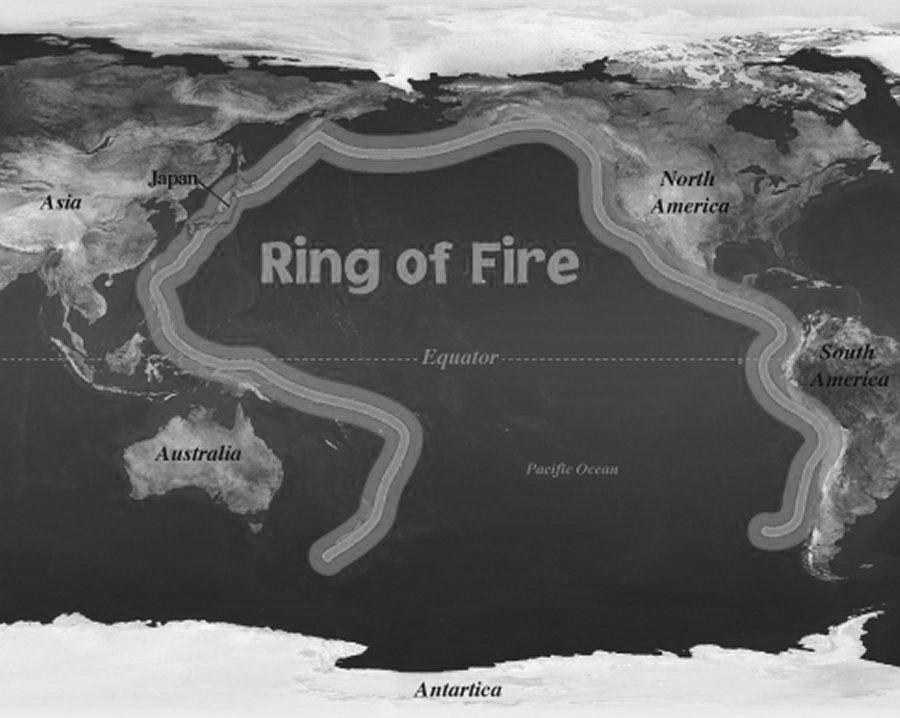
2.3.4 The Ring of Fire is a major area in the basin of the Pacific Ocean where a large number of earthquakes and volcanic eruptions occur. San Francisco is located on the Ring of Fire.
The San Andreas Fault and 6 other significant fault zones are present in the Bay Area: the Calaveras, Concord-Green Valley, Greenville, Hayward, Rodgers Creek, and San Gregorio Faults. In the last half of the 1800’s, potentially damaging earthquakes (magnitude 6.0 or greater) occurred in the San Francisco Bay Area at an average rate of once every four years. However, seismicity rates dropped dramatically after the 1906 earthquake: scientists believe the large stress release of the 1906 earthquake also relieved stresses on faults throughout the Bay Area. Seismic activity was very low until the 1989 Loma Prieta (6.9 magnitude) earthquake. The level of seismic activity has not yet returned to that of the late 1800’s, but as stresses continue to build scientists expect more frequent and stronger earthquakes in the future.1
2.3.4.1 Fire after Earthquake
Fire has long been recognized as a major hazard following earthquakes. Before the 20th Century, earthquakes would often upset burning candles, lamps, stoves and fireplaces (with dangerous fuels common). Today in the US ruptured gas lines and arcing electrical wires are the most common sources of ignition. In addition to providing chances for ignition, earthquakes can block access to firefighting equipment, and damage fire-fighting water supplies, making fighting the blazes, of which there might be many across a city, especially challenging.
The most famous earthquake-initiated fires in US history burned much of the City of San Francisco in 1906. Up to 90% of building damage, after the earthquake, was attributed to the fires and the crude firefighting techniques employed in an effort to contain the blaze. 2
Preparing your home and controlling utilities after earthquake can play an important role in decreasing the risk of fire after earthquake.
2.4 DURING AN EMERGENCY
2.4.1 Protective Actions
Because many disasters occur with little or no warning, individuals need to have the knowledge and skills to take immediate protective actions in the first critical moments after a disaster has occurred, before you have instruction from authorities. While the specific action to take is based on the disaster type, the amount of warning, whether you are inside, outside, or driving, and the amount of training you have, the following list provides a good overview of the protective actions you should be familiar with. These should be your objectives in assessing your post-event environment.
Assess situation:** When something occurs without notice, take a few seconds to assess the situation to determine the most effective next steps. Identify the type of event and whether air or a building structure has been compromised.**
Decide to stay or change locations:** In some instances, you should stay where you are (if you are inside and an event has occurred outside, you may need to stay inside) and in other circumstances you should change location (if you are inside and the event is inside, you may need to evacuate the building). All disasters have unique attributes, so it is important for you to realize that you need to evaluate the circumstances to determine the best course of action.**
Staying or changing location is a critical early decision in disasters. If you are not in immediate danger, you should stay where you are and get more information before taking your next steps. Thinking through the likely hazards in your community and where you might be when an event occurs may help you visualize your response. While you may need to make the first, immediate decision to stay inside or go outside, or to shelter in place by sealing a room without authoritative instruction, it is important that you listen to local authorities when that information is provided. If experts tell you to evacuate from your location, LEAVE!
Seek clean air and protect breathing passages. Regardless of the type of disaster, clean air is a critical need. Actions to protect your breathing passages and seek clean air may include covering your mouth with a cloth or mask, vacating the building, or sheltering in place by sealing an internal room while the airborne contaminant dissipates.
Protect yourself from debris and signal rescuers if trapped.** Protecting yourself from falling or precarious debris is a critical protective action. If you become trapped, protect your airways, bang on an object, or blow a whistle. Yelling should be a last resort.** Remove contaminants.
If contaminants have been released into the area or you have contacted liquid or solid contaminants, it is critical that you remove the contaminants as quickly as possible.** Remove contaminated clothing and wash with soap and water starting at the head and working toward the feet.**
Practice good hygiene.** Good hygiene is a preventive measure for spreading disease, and it’s important to be mindful of hygiene in a post-disaster environment. Clean drinking water and sanitation are important protective actions.**
2.4.2 What to Do During an Earthquake3
2.4.2.1 If You Are Inside a Building:
2.4.3 Drop down onto your hands and knees so the earthquake doesn’t knock you down. Drop to the ground (before the earthquake drops you!)
2.4.4 Cover your head and neck with your arms to protect yourself from falling debris.
2.4.5 If you are in danger from falling objects, and you can move safely, crawl for additional cover under a sturdy desk or table.
If no sturdy shelter is nearby, crawl away from windows, next to an interior wall. Stay away from glass, windows, outside doors and walls, and anything that could fall, such as light fixtures or furniture.
2.4.6 Hold on to any sturdy covering so you can move with it until the shaking stops.
Stay where you are until the shaking stops. Do not run outside. Do not get in a doorway as this does not provide protection from falling or flying objects, and you may not be able to remain standing.
2.4.7 If getting safely to the floor will be difficult, take actions before an earthquake to secure or remove items that can fall or become projectiles.
Stay away from windows and objects that could fall on you. The Earthquake Country Alliance advises getting as low as possible to the floor. People who use wheelchairs or other mobility devices should lock their wheels, bend over, and remain seated until the shaking stops. Protect your head and neck with your arms, a pillow, a book, or whatever is available.
Studies of injuries and deaths caused by earthquakes over the last several decades show that you are much more likely to be injured by falling or flying objects (TVs, lamps, glass, bookcases, etc.) than to die in a collapsed building. “Drop, Cover, and Hold On” (as described above) will protect you from most of these injuries.
2.4.7.1 If You Are in Bed When You Feel the Shaking:
If you are in bed, stay in bed and Cover your head and neck with a pillow. At night, hazards and debris are difficult to see and avoid; attempts to move in the dark result in more injuries than remaining in bed.
2.4.7.2 If You Are Outside When You Feel the Shaking:
2.4.8 If you are outdoors when the shaking starts, move away from buildings, streetlights, and utility wires. Once in the open, “Drop, Cover, and Hold On.” Stay there until the shaking stops.
2.4.8.1 If You Are in A Moving Vehicle When You Feel the Shaking:
It is difficult to control a vehicle during the shaking. If you are in a moving vehicle, stop as quickly and safely as possible and stay in the vehicle. Avoid stopping near or under buildings, trees, overpasses, and utility wires. Proceed cautiously after the shaking. Avoid roads, bridges, or ramps that the earthquake may have damaged.
2.5 IMPACT ON INFRASTRUCTURE
2.5.1 Examples of Possible Impact from Damage to Infrastructure
| Damage to . . . | Possible Effects |
| Transportation | Inability to assess damage accurately |
| Ambulances prevented from reaching survivors | |
| Police prevented from reaching areas of civil unrest | |
| Fire departments prevented from getting to fires | |
| Flow of needed supplies (food, water, etc.) is interrupted | |
| Roads are closed and/or impassable | |
| Structures | Damaged critical facilities (e.g., hospitals, fire stations, police precincts, airports) unable to function normally |
| Increased risk of damage from falling debris | |
| Communication Systems | Survivors unable to call for help |
| Coordination of services is hampered | |
| Families and friends cannot communicate | |
| Utilities | Loss of service |
| Increased risk of fire or electrical shock | |
| Limited access to fuel, e.g., pumps that may not work | |
| Loss of contact between survivors and service providers | |
| Water Service | Medical facilities hampered |
| Inadequate water flow, which results in notice to boil water and hampered firefighting capabilities | |
| Increased risk to public health | |
| Fuel Supplies | Increased risk of fire or explosion from fuel line rupture |
| Risk of asphyxiation | |
| Financial Services | ATM machines do not work |
| Credit card systems inoperable |
2.5.1.1 Results of Damage to the Infrastructure
Each instance of damage to the infrastructure may severely restrict the abilities of police, fire, and emergency medical services in that disaster.
Because emergency services personnel are likely to have inadequate resources to meet the public’s needs, those resources must be applied according to the highest- priority need.
- Police will address incidences of grave public safety.
- Firefighters will suppress major fires and conduct technical rescue.
- Fire EMS personnel will handle life-threatening injuries. You should be aware, however, that NERTs will also handle life-threatening injuries until EMS units become available.
- Lower priority needs will have to be met in other ways.
2.6 LOCAL ALERTS & WARNING SYSTEMS
2.6.1 Outdoor Public Warning System (OPWS)
The City’s Outdoor Public Warning System is designed to alert residents and visitors of San Francisco about possible danger. Specific emergency announcements can be broadcast over any (or more) of the 109 sirens which are located on poles and on top of buildings throughout all neighborhoods in San Francisco, Treasure Island, and Yerba Buena. As of December 2019, the system is shut down for an upgrade.
2.6.2 Emergency Alerting System (EAS)
The Emergency Alert System (EAS) is a national public warning system that requires broadcasters, cable television systems, wireless cable systems, satellite digital audio radio service (SDARS) providers, and direct broadcast satellite (DBS) providers to provide the communications capability to the President to address the American public during a national emergency. The system also may be used by state and local authorities to deliver important emergency information, such as AMBER alerts and weather information targeted to specific areas. Messages are preceded by a high-pitched alert tone.
2.6.3 ALERTSF.ORG
AlertSF is a text-based notification system for San Francisco. AlertSF will send alerts regarding emergencies disrupting vehicle/pedestrian traffic, watches and warnings for tsunamis, flooding, and Citywide post-disaster information to your registered wireless devices and email accounts.
You will receive time-sensitive messages wherever you specify, such as your home, mobile or business phones, email address, text messages and more. You pick where; you pick how. Visit the website www.alertsf.org to register or text alertsf to 888-777 on cellular phone.
2.7 OTHER EMERGENCIES
2.7.1 Tsunami
A tsunami or tidal wave, also known as a seismic sea wave, is a series of waves in a water body caused by the displacement of a large volume of water, generally in an ocean or a large lake. Earthquakes, volcanic eruptions and other underwater explosions (including detonations of underwater nuclear devices), landslides, meteorite impacts and other disturbances above or below water all have the potential to generate a tsunami. Unlike normal ocean waves, a tsunami is generated by the displacement of water.
2.7.1.1 Local Tsunami
This is a tsunami where its destructive effects are experienced on coasts within 100 km (62 miles) from the source of the tsunami. In such cases, the travel time for the tsunami is generally less than one hour. A local tsunami is usually generated by an earthquake but can also be caused by a landslide or a pyroclastic flow from a volcanic eruption.
Locally generated tsunamis are especially dangerous. This type of tsunami may reach a nearby shore in less than ten minutes. In such cases, there is not sufficient time for a Tsunami Warning Center or for local authorities to issue an official tsunami warning. Coastal residents and users should therefore take life-saving action as indicated on the sign based on the shaking of the ground, which is a warning that a tsunami may be imminent. The type of earthquakes generated locally make this unlikely but not impossible.
2.7.1.2 Regional Tsunami
A tsunami capable of destruction in an area which lies between 100 km - 1,000 km (62-620 miles) from the source of the tsunami. Regional tsunamis can take between 1-3 hours to reach the affected shoreline. The most destructive tsunamis can be local or regional.
2.7.1.3 Distant Tsunami
Also referred to as a tele-tsunami or ocean-wide tsunami, distant tsunamis originate from a faraway source, more than 1000 km (620 miles) and generally take more than 3 hours to arrive at affected coasts.
When a tsunami is formed, the waves generally radiate and move in opposite directions. In this case, a local tsunami can impact on coastlines which are close to the tsunami source. The waves which are moving in other directions away from the source of the tsunami, can continue to travel across entire ocean basins as distant tsunamis with sufficient energy to cause additional casualties and destruction on far away shores.
These types of tsunamis allow more time for the Warning Centre to collect data and issue precise bulletins, and for local officials to communicate warning information and alert the vulnerable populations.
2.7.1.4 Inundation Zones4
Inundation zones in San Francisco include Ocean Beach, the Marina Green, the Embarcadero and part of Bayview.
There are two types of tsunami warnings: official and natural. Both are important. You may not get both. Respond immediately to whichever you receive first.
- Stay out of the water and away from beaches and waterways.
- Follow evacuation signs or go as high or far inland (away from the water) as possible.
- Get more information from radio, television, or your mobile device (text or data).
2.7.1.5 Natural Tsunami Warning
- A strong or long earthquake
- A loud roar (like a train or an airplane) from the ocean
- Unusual ocean behavior. The ocean could look like a fast-rising flood or a wall of water, or it could drain away suddenly like a very low, low tide.
2.7.1.6 Official Tsunami Warning and Alert levels5
Official tsunami warnings are broadcast through radio, television, and wireless emergency alerts. They may also come through outdoor sirens, officials, text message alerts, and telephone notifications.
- Tsunami Warning – A tsunami warning is issued when a tsunami with the potential to generate widespread inundation is imminent, expected, or occurring. Warnings alert the public that dangerous coastal flooding accompanied by powerful currents is possible and may continue for several hours. GET TO HIGH GROUND.
- Tsunami Advisory – A tsunami advisory is issued when a tsunami with the potential to generate strong currents or waves dangerous to those in or very near the water is imminent, expected, or occurring. The threat may continue for several hours after initial arrival, but significant inundation is not expected for areas under an advisory. STAY OUT OF WATER AND AWAY FROM BEACHES.
- Tsunami Watch – A tsunami watch is issued when a tsunami may later impact the watch area. The watch may be upgraded to a warning or advisory or canceled based on updated information and analysis. Emergency management officials and the public should prepare to act. STAY TUNED FOR MORE INFORMATION AND BE PREPARED TO ACT
- Tsunami Information Statement – A tsunami information statement is issued when an earthquake or tsunami has occurred of interest to the message recipients. In most cases, information statements are issued to indicate there is no threat of a destructive basin-wide tsunami and to prevent unnecessary evacuations.
2.7.2 Power Outage Safety Tips6
- Only use flashlights or lanterns for emergency lighting. Candles can cause fires.
- Keep refrigerator and freezer doors closed. Most food requiring refrigeration can be kept safely in a closed refrigerator for several hours. An unopened refrigerator will keep food cold for about 4 hours. A full freezer will keep the temperature for about 48 hours. Throw away any food that has been exposed to temperatures 40° F (4° C) for 2 hours or more or that has an unusual odor, color or texture. When in doubt, throw it out!
- Take steps to remain cool if it is hot outside. In intense heat when the power may be off for a long time, consider going to a movie theater, shopping mall or “cooling shelter” that may be open in your community. If you remain at home, move to the lowest level of your home, since cool air falls. Wear lightweight, light-colored clothing. Drink plenty of water, even if you do not feel thirsty.
- Put on layers of warm clothing if it is cold outside. Never burn charcoal for heating or cooking indoors. Never use your oven as a source of heat. If the power may be out for a prolonged period, plan to go to another location (the home of a relative or friend, or a public facility) that has heat to keep warm.
- Turn off or disconnect appliances and other equipment in case of a power “surge” that can damage computers and other devices. Consider adding surge protectors.
- If you are considering purchasing a generator for your home, consult an electrician or engineer before purchasing and installing.
- Only use generators away from your home and NEVER run a generator inside a home or garage or connect it to your home’s electrical system.
2.7.3 Storms and Flooding Safety Tips
- Turn Around, Don’t Drown! ®
- Avoid walking or driving through flood waters.
- Do not drive over bridges that are over fast-moving floodwaters. Floodwaters can scour foundation material from around the footings and make the bridge unstable.
- Just 6 inches of moving water can knock you down, and one foot of moving water can sweep your vehicle away.
- If there is a chance of flash flooding, move immediately to higher ground.
- If floodwaters rise around your car but the water is not moving, abandon the car and move to higher ground. Do not leave the car and enter moving water.
- Return home only when authorities say it is safe.
- Be aware of areas where floodwaters have receded and watch out for debris.
- Avoid standing water as it may be electrically charged from underground or downed power lines.
- Avoid contact with flood water as it may contain sewage and other contaminates
2.8 HOME & WORKPLACE PREPAREDNESS
FEMA conducts a national household survey to measure the public’s attitudes, perceptions, and actions taken for personal preparedness. Research findings provide some interesting insights on public expectations and beliefs. Findings from the 2023survey include:
- Perceived preparedness: About 51% of Americans reported they felt prepared for a disaster, a 9% increase from 2017.
- Preparedness actions: 57% of respondents took at least three actions to prepare for a disaster in the preceding year. The most common actions were assembling or updating disaster supplies (48%) and making an emergency plan (37%).
- Influence of information: Of those surveyed, 89% had received preparedness information in the past year. This group was five times more likely to have taken preparedness steps compared to those who had not received information.
- Disconnect among older adults: While adults 60 and older felt as prepared as younger adults, they were less likely to have taken multiple preparedness actions.
- Barriers for disadvantaged groups: People with socioeconomic disadvantages were less likely to take higher-cost preparedness actions, though they were about as likely to take low- or no-cost actions.
2.8.1 Preparing for a Disaster
Many preparedness actions are useful in any type of emergency, and some are specific to a particular type of disaster. A critical first step to preparedness is to understand the hazards in your community and to learn about local alerts and warning systems, evacuation routes, and sheltering plans. It is also important to familiarize yourself with hazards in other areas when you are traveling and may experience a type of hazard you are not as familiar with.
Regardless of the type of disaster, important elements of disaster preparedness include:
- Having a battery-operated or hand-crank radio to tune into KQED 88.5 FM and KFBK 1530 AM for the latest news and updates.
- Having the skills to evaluate the situation quickly and to take effective action to protect yourself
- Having a family disaster plan and practicing the plan with drills
- Assembling supplies in multiple locations
- Reducing the impact of hazards through mitigation practices
- Getting involved by participating in training and volunteer programs
It is also always important to address specific needs for yourself and people you know, including any access or functional needs, considerations for pets and service animals, and transportation.
More information on preparedness is available online.
2.8.1.1 Web Resources
| URL | Description |
|---|---|
| www.ready.gov/ | FEMA’s national Web site for disaster preparedness. Excellent general advice and a good place to start. |
| https://www.ready.gov/sites/default/files/2021-11/are-you-ready-guide.pdf | Are You Ready? is a 200-page FEMA publication that provides a step-by-step approach to disaster preparedness and specific information by disaster type. |
| www.pandemicflu.gov | The Centers for Disease Control and Prevention (CDC) established this Web site as a hub for national information on pandemic influenza. |
| https://www.sf.gov/readysf | ReadySF is SF’s website for emergency preparedness. You’ll find information about what to do in an emergency, simple steps to get connected, and useful guides to help you get prepared. |
| Tune Into Online: KQED 88.5 FM and KFBK 1530 AM for the latest news and updates. |
2.8.2 Developing a Disaster Plan
In addition to knowing immediate protective actions that you may need to take; an emergency plan can mean the difference between life and death in a disaster. For example:
- Where will you meet family members? You should have a location outside the house and another location outside the neighborhood.
- Identify an out-of-state “check-in contact.”
- Plan for all possibilities: extended stay, shelter-in-place, or evacuation.
- How will you escape buildings where you spend time: your home, workplace, school, place of worship?
- What route (and several alternatives) will you use to evacuate? Do you have transportation?
Family safety is the most important factor when disaster strikes. To make the best decision regarding your family’s safety, you should always first consider what is best given the situation. It is also essential that you practice your plan with your family
— evacuating the home and contacting all family members using your “check-in contact.” Practicing your plan now will improve your performance when it matters most.
2.8.2.1 Get Started
Meet with your family.
- Discuss the types of disasters that could occur.
- Explain how to prepare and respond.
- Create a checklist.
- Discuss what to do if advised to evacuate.
- Practice what you have discussed.
Plan how your family will stay in contact if separated by disaster. Pick two meeting places:
- A location a safe distance from your home in case of fire
- A place outside your neighborhood in case you can’t return home
Choose an out-of-state friend as a “check-in contact” for everyone to call.
- Make sure that the person selected understands that they are your out-of-state contact in case of emergency and what you would expect of them should such an emergency arise.
- Give your “check-in contact” person a list of pertinent people to contact. Be sure to include phone numbers!
- Periodically practice using your local and out-of-state contacts as if it were an emergency.
Complete the following steps:
- Post emergency telephone numbers by every phone.
- Show responsible family members how and when to shut off water, gas, and electricity at main switches.
- Install a smoke alarm on each level of your home, especially near bedrooms; test them monthly and change the batteries two times each year.
Meet with your neighbors and network. (Ready My Neighbors packet in Appendix)
- Plan how the neighborhood could work together after a disaster. Know your neighbors’ skills (medical, technical).
- Create a roster with skills and equipment.
- Map of your neighborhood/block.
- Consider how you could help neighbors who have special needs, such as elderly or disabled persons.
- Make plans for childcare in case parents can’t get home.
- Talk to your child’s school. Learn their plans.
2.8.2.2 In Case of Emergency…Activate Plan
- Text or call your “check-in”
- Update your status on social media
- Update your outgoing Voicemail to reflect your current status
- Go to your meeting place if needed
Create an Escape Plan
- Draw a floor plan of your home. Include all possible emergency exits.
- Mark two ways out of every room.
- Identify anyone who needs help to escape.
- Choose a meeting place outside.
- Instruct your family/roommates to call the fire department from a neighbor’s home.
Home Activity: Evacuate!Escape PlanningDevelop an escape plan that provides for escape from every room:Consider the needs of children and individuals with disabilities.Inform all family members or office coworkers of the plan.Run practice escape drills.Practice your plans:Conduct family fire drills.Follow the local evacuation routesAn example of a home escape plan is shown in the figure that follows.Home Activity: Evacuate!Escape PlanningDevelop an escape plan that provides for escape from every room:Consider the needs of children and individuals with disabilities.Inform all family members or office coworkers of the plan.Run practice escape drills.Practice your plans:Conduct family fire drills.Follow the local evacuation routesAn example of a home escape plan is shown in the figure that follows.
2.8.2.3 Escape Plan
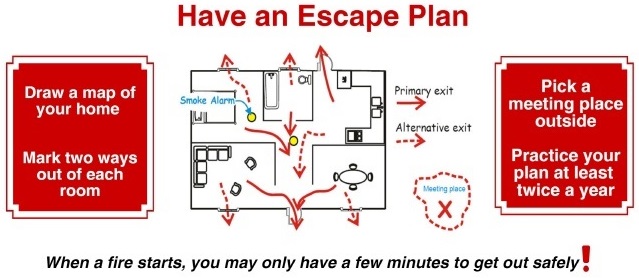
Sample family escape plan with arrows showing an escape route from every room in the home and a family meeting place outside the home
It is important to have an escape plan that:
- Includes escape from every room of the house or every area of the workplace
- Considers the needs of children and individuals with disabilities
In most cases, homeowners won’t have smoke alarms in every room, but it is important to have a smoke alarm at least on every level of the house.
2.8.2.4 Review Your Plan
Nothing ever stays the same. That’s why it’s important to take time to update your personal Emergency Preparedness Plan at least every year. You never know when an emergency will occur. An up-to-date plan will make sure you and those you care about will be able to take quick action to keep everyone as safe as possible.
Carefully review your plan. Think about changes in your residence, children’s’ school, staff, job, out-of-state contact’s situation, etc. All these can affect your plan. Update as needed.
2.8.3 Assembling and Storing Disaster Supplies
You can cope best by preparing for disaster before it strikes. One way to prepare is to assemble disaster supplies in multiple locations. After disaster strikes, you won’t have time to shop or search for supplies. But if you’ve gathered supplies in advance, you and your family can endure an evacuation or home confinement.
2.8.3.1 Storing your Supplies
Since you do not know where you will be when an emergency occurs, prepare supplies for home, work and vehicles.
- Home: Keep this kit in a designated place and have it ready in case you have to leave your home quickly. Make sure all family members know where the kit is kept. Keep specific equipment in ready-to-use locations such as: shoes and your “what-to-do checklist” under your bed in case of earthquake.
- Work: Be prepared to shelter at work for at least 24 hours. Your work kit should include food, water and other necessities like medicines, as well as comfortable walking shoes, stored in a “grab and go” case.
- Vehicle: In case you are stranded, keep a kit of emergency supplies in your car.
2.8.3.2 To Prepare Your Kit
- Review the checklist on the next few pages.
- Gather the supplies from the list. Remember that many households already have many of the items needed for your kits. These items can be assembled in appropriate locations for quick access in an emergency but used under normal circumstances whenever needed. For example, keep a wrench in your kit to shut off gas at the meter in an emergency, but use the wrench for everyday tasks, too. Just be sure to return it to the emergency kit.
- Place the supplies you’re apt to need for an evacuation in an easy-to-carry container aka a GO-Bag. These supplies are listed with an asterisk (*).
WATER
To fill your own bottles, store water in plastic containers such as soft drink bottles.
- Look for the triangular recycling symbol with a number 1 on the bottom of the bottle as those are best for water storage. Avoid using containers that will decompose or break, such as plastic milk jugs or glass bottles.
- Wash the bottle with soap and warm water, fill with water from your tap, and store in a cool, dark area away from direct sunlight.
- Replace your emergency water every 6 months by repeating the process; like food and batteries, water does expire!
Keep in mind that a normally active person needs to drink at least 2 quarts of water each day. Hot environments and intense physical activity can double that requirement. Children, nursing mothers, and ill people will need more. If you purchase bottled water, there is an expiration date on the bottle to indicate when to replace the bottles.
- Store 1 gallon of water per person per day (2 quarts for drinking, 2 quarts for food preparation and sanitation). *
- Keep a 3-5-day supply of water for each person in your household.
If you have questions about the quality of the water, purify it before drinking. You can heat water to a rolling boil for 1 minute or use commercial purification tablets to purify the water. You can also use regular household liquid chlorine bleach if it is pure 5.25% sodium hypochlorite. (Do not use perfumed bleach!)
2.8.4 Ratios for Purifying Water with Bleach (Per FEMA)
| Water Quantity | Bleach Added |
|---|---|
| 1 Quart 1 Gallon 5 Gallons | 4 Drops 16 Drops 5/8 Teaspoon |
Note: If water is cloudy, double the recommended dosage of bleach.
After adding bleach, shake— or stir the water container and let it stand 30-60 minutes before drinking.
FOOD
Store a 3-5-day supply of nonperishable food. Select foods that require no refrigeration, preparation, or cooking and little or no water. If you must heat food, pack a can of Sterno®. Select food items that are compact and lightweight. Avoid salty foods if possible as they increase thirst. Include a selection of the following foods in your disaster supply kit. Check food and water expiration dates twice a year. Rotation is key to avoiding spoils so choose foods you will eat or can donate to a local food drive. Ready-to-eat canned meats, fruits, and vegetables
- Canned juices, milk, soup (if powdered, store extra water)
- Staples— sugar, salt, pepper
- High-energy foods— peanut butter, jelly, crackers, granola/protein bars, trail mix
- Foods for infants, elderly people, or persons on special diets
- Comfort and stress foods— cookies, hard candy, sweetened cereals, lollipops, instant coffee, tea bags
Kitchen Items
- Manual can opener
- Mess kits or paper cups, plates, and plastic utensils
- All-purpose knife
- Household liquid bleach to treat drinking water
- Aluminum foil and plastic wrap
- Re-sealing plastic bags
- If food must be cooked, small cooking stove (to be used OUTSIDE) and a can of cooking fuel
First Aid Kit*
Assemble a first aid kit for your home and one for each car. (Note: This kit is not intended to supplement or replace a NERT member responder supply kit!) A first aid kit should include:
- First aid manual
- Sterile adhesive bandages in assorted sizes
- Two-inch sterile gauze pads (4-6)
- Four-inch sterile gauze pads (4-6)
- Hypoallergenic adhesive tape
- Triangular bandages (3)
- Needle
- Moistened towelettes
- Antibacterial ointment
- Thermometer
- Tongue blades (2)
- Tube of petroleum jelly or other lubricants
- Assorted sizes of safety pins
- Cleaning agent/soap
- Non-latex exam gloves (2 pairs)
- Cotton balls
- Sunscreen
- Three-inch sterile roller bandages (3 rolls)
- Four-inch sterile roller bandages (3 rolls)
- Scissors
- Tweezers
- Hot and cold compress
- Nonprescription Drugs
- Aspirin or non-aspirin pain reliever
- Antidiarrhea medication
- Antacid (for stomach upset)
- Allergy medication and if necessary, epinephrine
- Laxative
- Vitamins
- Activated charcoal (used if advised by the Poison Control Center)
Tools and Supplies
- Emergency preparedness manual*
- Battery-operated weather radio and extra batteries. Tune into KQED 88.5 FM and KFBK 1530 AM *.
- Flashlight and extra batteries*
- Fire extinguisher: small canister, ABC type
- Tube tent
- Pliers
- Duct tape
- Compass*
- Matches in a waterproof container
- Plastic storage containers
- Signal flare(s)*
- Paper, pencil*
- Needles, thread
- Work gloves
- Medicine dropper
- Non-sparking shutoff wrench to turn off household gas and water
- Whistle
- Plastic sheeting
- Landline telephone
- Fuel for vehicle and generator
** Sanitation**
- Toilet paper, towelettes*
- Soap, liquid detergent*
- Feminine supplies*
- Personal hygiene items*
- Plastic garbage bags, ties (for personal sanitation uses)
- Plastic bucket with tight lid
- Disinfectant
- Liquid hand sanitizer
- Household chlorine bleach
Pet Supplies
- Medications and medical records (stored in a waterproof container) and a first aid kit
- Current photos of your pets in case they get lost
- Information on feeding schedules, medical conditions, behavior problems, and the name and number of your veterinarian in case you must foster or board your pets
- Sturdy leashes, harnesses, and/or carriers to transport pets safely and ensure that your animals can’t escape
- Food, potable water, bowls, cat litter and pan, and can opener
- Pet beds and toys, if easily transportable
Clothing and Bedding
Include at least one complete change of clothing and footwear per person (and remember to change for the different seasons!).
- Sturdy shoes or boots*
- Rain gear*
- Blankets or sleeping bags*
- Hat and gloves*
- Thermal underwear*
- Sunglasses*
Household Documents and Contact Numbers*
Be sure to store these in a watertight container:
- Personal identification, cash (including change) or traveler’s checks, and a credit card
- Copies of important documents: - birth certificate, marriage license - driver’s license - Social Security card, Passport - wills, deeds - inventory of household goods, insurance papers - contracts, bank and credit card account numbers, stocks/bonds. - immunization records
- Emergency contact list and other important phone numbers
- Map of the area and phone numbers of places you could go
- An extra set of car keys and house keys
- Copies of prescriptions and/or original prescription bottles
Special Items
Remember family members with special needs, such as infants and elderly or those with disabilities.
2.8.5 For Baby*
- Formula
- Diapers
- Bottles
- Powdered milk
- Medications
2.8.6 For All Family Members
- Heart and high blood pressure medication*
- Insulin*
- Other prescription drugs*
- Denture needs*
- Contact lenses and supplies*
- Extra eyeglasses*
- Entertainment - games and books
- Cash in small bills
- Keep gas tank half full
*Items marked with an asterisk are recommended for evacuation.
2.8.7 Commodity Points of Distribution
A Point of Distribution or POD is where the public goes to pick up emergency supplies following a disaster. The need for a POD is based on lack of infrastructure to support normal distribution of food, water, or other supplies.
A POD should accommodate vehicles, pedestrians, mass transit traffic, or a combination of all three. You should plan for how you will get to a POD and then how you will carry items you may receive.
2.9 Reducing the Impact of Hazards Through Mitigation
In addition to managing the impact that a disaster would have on you and your family by assembling disaster supplies, mitigation will also help. Mitigation is the reduction of loss of life and property by lessening the impact of disasters. Mitigation includes any activities that prevent an emergency, reduce the likelihood of occurrence, or reduce the damaging effects of unavoidable hazards. Mitigation can include structural changes, non-structural measures, and purchasing appropriate insurance.
2.9.1 Structural Hazards
2.9.1.1 HAZARDS FROM HOME FIXTURES
Some of the hazards include:
- Gas line ruptures from water heaters or ranges displaced by shaking, water, or wind
- Damage from falling books, dishes, or other cabinet contents
- Risk of injury or electric shock from displaced appliances and office equipment
- Fire from faulty wiring, overloaded plugs, frayed electrical cords
It is also important to know how and when to turn off utilities safely. (Utility shutoffs will be covered in Unit 2).
2.9.1.2 STRUCTURAL CHANGES
Some mitigation measures require a bigger investment to address structural changes to reduce the impact of disasters. Depending on the likely hazards in your area, these may include:
- Bolt house to foundations.
- Install plywood as shear walls.
- Strap mobile homes to their slabs.
- Raise utilities (above the level of flood risk).
- Build a safe room*.
You can learn more about San Francisco’s retrofit ordinances and support from the Earthquake Safety Implementation Program (ESIO) http://sfgov.org/esip/ managed by the Office of Recovery and Capital Planning. Phone: (415) 554-4925.
*See sheltering section page 1-31
2.9.2 Non-structural Mitigation
Non-structural hazard mitigation includes relatively simple actions you can take to prevent home furnishings and appliances from causing damage or injuries during any event that might cause them to shift. Use ‘Earthquake Eyes’ to identify non-structural hazards in your surroundings.
In addition to structural hazards, everyone has non-structural hazards in their neighborhood, homes, or workplaces. Fixtures and items within a home, garage, or workplace can pose a hazard during or after a disaster. Reducing hazards is an important part of personal preparedness.
Examples of non-structural hazard mitigation include:
- Anchor heavy furniture.
- Secure appliances and office equipment.
- Install hurricane storm shutters.
- Secure cabinet doors with childproof fasteners.
- Locate and label gas, electricity, and water shutoffs.
- Secure water heaters and have flexible gas lines installed.
2.9.2.1 Personal Insurance
You should ensure your homeowner’s/renter’s policy provides adequate coverage and covers appropriate hazards in your area. In addition, homeowner’s insurance does not automatically cover damage caused by flooding or earthquake, so it is important to know your risks.
Visit the National Flood Insurance Program website, www.floodsmart.gov, and/or the California Earthquake Authority website,https://www.earthquakeauthority.com/, to learn more. Then consult with your Insurance Agent.
2.9.3 FORTIFYING YOUR HOME
| Type of Hazard | Sample Precautions |
|---|---|
| Structural | Bolt older houses to the foundation. Install trusses or hurricane straps to reinforce the roof. Strap propane tanks and chimneys. Strap mobile homes to their concrete pads. Raise utilities (above the level of flood risk). Ask a professional to check the foundation, roof connectors, chimney, etc. |
| Non-Structural | Anchor such furniture as bookshelves, hutches, and grandfather clocks to the wall. Secure appliances and office equipment in place with industrial-strength Velcro®. Install hurricane storm shutters to protect windows. Secure cabinet doors with childproof fasteners. Locate and label shutoffs for gas, electricity, and water before disasters occur. After a disaster, shut off the utilities as needed to prevent fires and other risks. Store a non-sparking shutoff wrench where it will be immediately available. Teach all home occupants, including children who are old enough to handle the responsibility, when and how to shut off the important utilities. Secure water heaters to the wall to safeguard against a ruptured gas line or loose electrical wires. |
Remember that different non-structural hazards pose different threats, depending on the disaster.
2.9.4 SHELTERING
There are different types of sheltering, and different types are appropriate for different disasters.
Shelter in place
Sealing a room. Sealing a room is a way to protect yourself from contaminants in the air for a short period of time until the contaminants dissipate. You should identify an internal room in your home, at work, or other locations where you spend a great deal of time. If sheltering-in-place is needed, you will be in this room for only a few hours, but it is important that you be able to seal the room quickly. Storing specific items in the room is helpful. You should have snacks and water; a battery-operated radio, a flashlight, and pre-cut plastic sheeting and duct tape to seal off vents and door and window openings.
Shelter for extended stay
Sheltering for an extended stay means that you would stay where you are for several days or, in the case of a pandemic, you may be asked to limit your time outside the home for up to 2 weeks. It is important to store emergency supplies for these possibilities.
‘Safe Enough to Stay’ is an initiative developed in a partnership between the Department of Building Inspection (DBI) and the San Francisco Bay Area Planning and Urban Research Association (SPUR) to temporarily alter building codes for damage due to widespread disaster that results in massive displacement. It is recommended that you take steps now to ensure that, after a major earthquake, you can “stay in place” — i.e., stay in your own homes while it is being repaired. See more at https://bit.ly/2hXa1fU.
Mass care/community shelter
These are congregate care facilities that house many people in one location. These shelters often provide water, food, medicine, and basic sanitary facilities but, if possible, you should take your 3-day disaster supplies kit (go-bag) with you so that you will be sure to have the supplies you require.
Safe Room
Please note, a safe room is NOT the same as a shelter-in-place location. A safe room requires significant fortification in order for the room to provide protection against extremely high winds.
2.10 SAFEGUARDING ANIMALS7
While fulfilling your duties as a NERT member, be aware that pet owner/guardians may put themselves in danger when faced with an emergency that could affect their animals. These pet owner/guardians may not be willing to comply with orders or requests until they know that their pet issues can be resolved. Our experience has shown that many people treat their pets as members of their family and will not evacuate without them.
2.10.1 Before Disaster Strikes…
2.10.1.1 Identify Your Pet
- Keep your pet’s license current.
- Make sure that collar and identification tags are worn at all times.
- Consider having a safe, permanent microchip implanted in your pet. This type of ID cannot fall off or be removed. Most veterinarians offer micro chipping services to their customers.
- Keep a photo of your pet in your personal go-kit.
2.10.1.2 Crate-Train Your Pet
Train your pet to enter his/her carrier or crate at your command. Try putting your pet’s favorite treat in his/her carrier and sounding a bell at the same time. Repeat this process every day, until your pet comes running at the sound of the bell. Continue this routine often enough to keep it fresh in your pet’s mind. This training will be extremely helpful when locating a frightened animal. Also, make sure your pet is comfortable being handled.
2.10.1.3 Prepare A First Aid Kit
Include any special medications prescribed by your veterinarian
2.10.1.4 Create A Pet Disaster Kit
A prepared disaster kit, kept in a safe and easily accessible place, will enable you to provide immediate care for your pet in an emergency. A calm, well-trained pet, which is either on leash, or in a carrier, will be more welcome wherever you go.
- Sturdy crate and/or pet carrier.
- Identification tags and collars and leashes.
- Food and water (a 7-day supply for each pet) and non-spill bowls.
- Litter box and litter.
- Manual can opener and plastic lid.
- Copy of your pet’s vaccination history.
- Recent photos of each pet.
- Pet First-Aid book; Pet First-Aid kit.
- Phone number of your local animal shelter (Animal Care and Control (415) 554-6364
- Large plastic bags for pet cleanup
2.10.1.5 Secure Bird Cages & Aquariums
Because these items may move and/or break during a disaster; securing them on low stands or tables is advisable. Tighten the latch on your birdcage so that the door cannot be shaken or open easily.
2.10.2 In Case of Disaster…
2.10.2.1 Evacuation
Red Cross shelters may not accept pets. Prepare a list of back up arrangements, such as homes of friends and family, hotels that allow pets, boarding facilities, veterinarians and/or shelters. It is generally not recommended that you leave your pet behind during an evacuation. If you must, follow these guidelines to help ensure your pet’s safety.
- Post a highly visible sign in a window to let rescue workers know who you left behind.
- Leave plenty of water in a large, open container that cannot be tipped over.
- Leave plenty of food in timed feeders (check local pet supply stores)
- Do not tie or cage your pet! The chances of survival are greater
2.10.2.2 If Your Pet Is Lost
Immediately call or visit the nearest animal shelter to report your missing pet.
When it is safe, return to your neighborhood to post or distribute “Lost Pet” posters. Be sure to include your name, home address phone number and a photo.
Continue to search the area for your pet. A frightened animal can stay hidden for days.
2.10.2.3 If You Find a Lost Pet
Notify your local animal shelter as soon as possible. Be prepared to give a description of the animal. Include breed, color, and sex and the location where the animal was found. Remember that sick and/or injured animals can become unpredictable from fear and pain and should be handled only by professionals with proper equipment.
2.10.3 GET TRAINED, STAY INVOLVED!
Preparedness requires active participation from all.
- Start the process by talking to your friends and family about the hazards in your area and what steps you all need to take to be able to help each other in a crisis – large or small.
- Ask about emergency planning at your workplace, your schools, your place of worship, and other social settings.
- Take training to acquire the skills you need to help others and keep your skills current through refresher training and practice.
- Your continued participation in the NERT Program will provide training, practice, and the connection with others to develop teams.
- Plan also to participate in drills and exercises with your family and neighbors and at your workplace, school, place of worship, and community-organized events. The more you practice, the better prepared you will be to take effective action when a disaster happens.
- Talk to your friends and family about volunteering, too. Volunteering to help your community through NERT and other activities is a great experience to share!
2.11 NERT Disaster Response
As described earlier in this unit, NERTs respond in the period immediately after a disaster when professional response resources are overwhelmed or delayed.
NERTs assist emergency response personnel when requested in accordance with standard operating procedures developed by the sponsoring agency, SFFD. Working as a team, members assume some of the same functions as emergency response personnel.
It was pointed out that, while NERTs are a valuable asset in emergency response, NERTs are not trained to perform all of the functions or respond to the same degree as professional responders. NERTs are a bridge to professional responders until they can arrive.
NERTs respond after a disaster by:
- Locating and turning off utilities, if safe to do so (Class 2)
- Extinguishing small fires (Class 2)
- Treating life-threatening injuries until professional assistance can be obtained(Class 3)
- Conducting light search and rescue operations (Class 4)
- Establishing a neighborhood command post to coordinate with the SFFD (Class 5)
- Helping disaster survivors cope with their emotional stressors (Class 5)
There is a distinction between how a NERT member responds to a disaster as an individual and how that member responds as part of a team.
A NERT member’s first responsibility is personal and family safety. Only after personal and family safety is secured is it possible and pertinent to respond in a group capacity to do what is necessary for the community as a whole. (Class 1)
In the NERT response, the team members report to the pre-identified meeting location — or staging area – select a leader (and an alternate) and— to begin response in the event of disaster. NERT members gather to organize and receive tasking assignments. Runners may be assigned to serve as a communication link between the staging area and the SFFD Battalion Fire Station or with NERT members working in the field. (Class 5)
In this way, NERT members can provide first for their own well-being and that of their family and, once appropriate, serve as part of the NERT responding to the disaster in the community.
In all instances, it is critical that NERT members stay within the limits of their training when providing disaster relief.
2.11.1 NERT NEIGHBORHOOD COMMAND POST ORGANIZATION
The chart below shows the basic NERT command structure. No matter which function NERT members are assigned to, effective NERTs require teamwork. NERT organization and team operations will be covered in detail in Session 5.
NERT Team Leader/SFFD LiaisonPlanningLeaderDocumentation/MapIncident StatusLogisticsLeaderTrack available NERT team members/suppliesOperations LeaderField Teams:- Small Fire Suppression-Search & Rescue-Medical-Damage AssessmentAdministrationFile completed documentationTeam leadersupport NERT Team Leader/SFFD LiaisonPlanningLeaderDocumentation/MapIncident StatusLogisticsLeaderTrack available NERT team members/suppliesOperations LeaderField Teams:- Small Fire Suppression-Search & Rescue-Medical-Damage AssessmentAdministrationFile completed documentationTeam leadersupport
2.11.2 CERT/NERT IN ACTION
Across the country, CERTs continue to be activated in a wide range of disaster and emergency support operations. For these efforts, CERT members and teams are receiving Federal, State, and local recognition for their response assistance.
In 2016, NERT received a FEMA Individual and Community Preparedness Award at the White House in recognition of our partnership with you, the community, to get our City prepared.
For brief profiles of how CERTs have assisted in actual emergencies all over the country, you can find stories in past Newsletters on the FEMA site:
Pre-Disaster Roles
NERT trained residents are a valuable asset for the community before any disaster. You can volunteer with non-emergency projects and roles such as:
- Distributing preparedness materials to neighbors and telling them about NERT
- Staffing preparedness displays at health fairs, street fairs, and other special events
- Assisting with the installation of smoke alarms with the Red Cross
- Fundraising for projects that augment the existing NERT program
- Leading your neighborhood team or assisting a neighborhood coordinator
- Organizing your block to become disaster ready
- Identifying your neighbors who might need assistance during an emergency or disaster and keeping that list with your neighborhood team.
- Staying trained and ready. Minimum training required is to recertify every two years by attending classes 5 & 6. In addition, NERT Training Day takes place on the third Saturday of every month.
2.12 ADDITIONAL TRAINING FOR NERTS
After completing basic NERT training, many NERT members seek to expand and improve their skills — through continuing training modules offered locally, courses offered through the American Red Cross, or programs from other sources.
SFFD and our partners offer the following training at no cost to NERT graduates unless indicated.
- Psychological First Aid for volunteer responders
- Drinking water post Disaster with the SF Public Utilities Commission (SFPUC)
- Gas and Electric Safety with Pacific Gas & Electric (PG&E)
- Amateur Radio Licensing (for a fee)
- Amateur Radio Operations – NERT Communications Team (NCT)
- SF Police Department Auxiliary Law Enforcement Response Team (ALERT) with the SF Police Department
- American Heart Association CPR/First Aid (for a fee)
There are also Independent Study (IS) courses available online from the Federal Emergency Management Agency (FEMA) that will be of interest to NERT members. Some of these include:
- IS-100 Introduction to Incident Command System
- IS-200 ICS for Single Resources and Initial Action Incidents
- IS-700 National Incident Management System (NIMS), An Introduction
- IS-800 National Response Framework, An Introduction
For a complete listing and access to FEMA Independent Study courses, visithttps://training.fema.gov/is/crslist.aspx
Class 1 Summary
Personal preparedness should be tailored to the hazards in your community and should include:
- knowing community alerts, warnings, and plans
- Developing household plans and conducting drills to practice
- Assembling disaster supplies in multiple locations
- Reducing hazards in the home
- Encouraging others to prepare and volunteering to help your community
Everyone in the community has the ability and responsibility to prepare for disasters.
The keys to NERT effectiveness are in:
- Familiarity with the types of events that are high risk for the area and the types of damage that can occur as a result
- Adequate preparation for each event and its aftermath
- Practice through refreshers and simulations
CERTs across the US have proven invaluable in the areas in which they were tested. They can be invaluable in this community as well.
2.12.1 HOMEWORK ASSIGNMENT
The next unit will cover fire safety, hazardous materials, utilities and terrorism awareness. Before the next session, you should:
- Review the detailed information in Chapter 1: Disaster Preparedness.
- Read and familiarize yourself with Chapter 2: fire safety, utility control, Hazardous material and Chapter 8, Terrorism & NERT in the Participant Manual
- Discuss preparedness with family and friends
- Make a communications plan, including an out-of-State “check-in contact”
- Begin to assemble supplies in multiple locations
- Examine your home for hazards and identify ways to prevent potential injury
- Begin to read Chapter 6, NERT Organization.
Source: USGS.GOV Website↩︎
https://pnsn.org/outreach/earthquakehazards/fire↩︎
https://www.ready.gov/earthquakes↩︎
http://www.conservation.ca.gov/cgs/geologic_hazards/Tsunami/Inundation_Maps/SanFrancisco↩︎
National Weather Service https://www.tsunami.gov/?page=message_definitions↩︎
https://www.ready.gov/power-outages↩︎
Information provided in this section is from the San Francisco Animal Care & Control website↩︎