7 Chapter 6: NERT ORGANIZATION
In this unit you will learn about:
- NERT Organization: How to organize and deploy NERT resources according to ICS organizational principles.
- Documentation: Strategies for documenting situation and resource status.
- Team Organization: A tabletop exercise to apply your knowledge of team organization
7.1 Introduction and Chapter 6 Overview
7.1.1 CHAPTER 6 OBJECTIVES
At the end of this chapter, you should be able to:
- Identify the teams and roles that NERT volunteers may take as part of a NERT team in a deployment.
- Describe how NERT volunteers work within the Incident Command System (ICS).
- Explain the documentation requirements for operating a team within the ICS.Note:* In this and other sections, NERT team members may be referred to as team members, rescuers, disaster workers, or volunteers.*
7.1.2 CHAPTER 6 TOPICS
This chapter will provide you with a thorough understanding of NERT organization, command post operations and policy.
- NERT Organization
- NERT Mobilization
- Documentation
Effective NERT operations, like all aspects of emergency response, rely on effective communication.
7.2 NERT Organization
7.2.1 PRINCIPLES OF ON-SCENE MANAGEMENT
On-scene management is how rescuers organize and respond to a disaster situation with three primary goals:
- Maintain the safety of disaster workers. Rescuer safety is the primary principle of on-scene management. All team members are expected to prioritize safety and operate within the scope of their capabilities and training. The ICS command structure defines specific responsibilities for team leaders.
- Provide clear leadership and organizational structure. The principle is that each NERT member has a role that defines the scope of his or her work, and reports to only one person. This is achieved by assigning roles and defining a clear chain of command understood by all team members. Each NERT volunteer has a role within one given functional team. The ICS (Incident Command System) defines the functional teams, and the lines of communication and command between teams and leaders.
- Improve the effectiveness of rescue efforts. The principle is to do the greatest good for the greatest number, while observing the two goals above.
NERT on scene management follows the Incident Command System (ICS), which is a proven management system used by emergency responders.
7.2.2 NERT ON-SCENE MANAGEMENT STRUCTURE & PROTOCOLS
NERT Staging Area: a predefined location to meet and establish the Emergency Response Team
Incident Command System (ICS) A well-defined and flexible framework to assemble and manage the Response Team, that prescribes the functional areas that must be staffed, the reporting chain, and the requirement to always work in teams.
- A manageable span of control that provides for a desirable ratio of between three and seven rescuers per supervisor.
- Predefined shared terminology for effective communication and shared understanding within the NERT team and with other teams and professional responders, such as firefighters and paramedics. This includes training for composing succinct yet complete messages, and the use of two-way radios.
- Consolidated action plans that coordinate strategic goals, tactical objectives, and support activities.
- Comprehensive resource management that facilitates application of available resources to the incident in a timely manner.
- Mechanisms to maintain accountability, both during on scene management (e.g., to ensure proper rest, or discover a team has not returned from an assignment as expected), and after the fact, to keep track of resources and effort expended as required by authorities.
NERT ORGANIZATION (CONTINUED)
7.2.3 OBJECTIVES FOR NERT ON-SCENE MANAGEMENT
Once assembled/deployed on-scene in a disaster situation, the NERT team:
- Identifies the scope of the incident (What is the problem?)
- Determines an overall strategy (What can we do, and how will we do it?)
- Deploys teams and resources (Who is going to do what?)
- Documents actions and results
7.2.4 THE NEED FOR FLEXIBILITY
Disasters create a dynamic, ever-changing environment. The NERT organizational framework is flexible so that it can expand or contract depending on the ongoing assessment priorities determined by the NERT Incident Commander/Task Force Leader (IC/TL), and people and resources available. This helps ensure:
- Rescuer safety
- Doing the greatest good for the greatest number
- A manageable span of control
- Accountability of NERT responders
7.2.5 INCIDENT COMMAND SYSTEM
The Incident Command System (ICS) is the system used by emergency response agencies to manage emergency operations. When NERTs activate, they become part of that system.
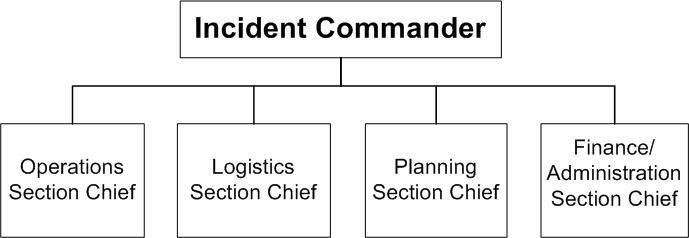
Basic ICS structure for NERT is established by the person who arrives first on the scene. This person becomes the Incident Commander/Task Force Leader (IC/TL). Initially, the IC/TL may handle all of the command positions of ICS but, as the incident evolves, he or she may assign personnel as needed to the four ICS Command Functions:
- Operations Section Chief
- Logistics Section Chief
- Planning Section Chief
- Finance/Administration Section Chief
Through an effective ICS, all NERT members report through a chain of command to the IC/TL. The IC/TL reports to the first fire or law enforcement official at their location and takes direction from that person until otherwise directed or until the NERT is relieved.
NERT ORGANIZATION (CONTINUED)
7.2.6 ICS COMMAND FUNCTION ORGANIZATION CHART
7.2.7 NERT COMMAND POST SECTIONS
- Although there are a number of detailed responsibilities under each ICS function, the system itself is straightforward. NERTs are required to set up and manage the Operations, Planning, and Logistics functions. The NERT Incident Commander/Task Force Leader (IC/TL) is responsible for handling or delegating each function.
- As the incident expands, NERT members are assigned or re-assigned to each section to handle specific aspects of the response while maintaining an effective span of control.
- NERT Incident Commander/Task Force Leader
- Provides overall leadership for incident response
- Ensures incident safety
- Establishes incident objectives
- Is responsible for all functions until delegated
- Delegates authority to others
- Provides information to internal and external parties
- Establishes and maintains liaison with other responders (e.g., fire, law enforcement, public works, other NERTs)
- Takes direction from agency officials
NERT Operations Section
- Directs and coordinates all incident tactical operations
- Is typically one of the first functions to be assigned
- Directs Field team responders
NERT ORGANIZATION (CONTINUED)
Planning Section
- Tracks situation status
- Prepares the Team’s action plan
- Provides NERT operations with field team directives and incidents
- Develops alternative strategies
- Provides documentation services
Logistics Section
- Tracks resource status (e. g., number of NERT members who have “reported for duty” and what section they are assigned to)
- Provides communications to IC/TFL
- Seeks sources of food and coordinates medical support to Team members
- Manages team supplies and facilities/staging area
Finance and Administration Section
- Timekeeping
- Track receipts for potential reimbursement. Reimbursement is not guaranteed for any purchase
- Organize and file all completed paperwork
Finance and Administration is a broader function in the formal Incident Command System; however, NERTs will have specific need for this function – tracking documentation.
7.2.8 NERT OPERATIONS
Based on the principles of ICS, NERTs follow these protocols:
- Each NERT must establish a command post structure at their staging area.
- The NERT Incident Commander/Task Force Leader (IC/TL) directs team activities. During activation for a disaster, the first person at the predesignated staging area assumes this responsibility. The initial IC/TL may hand off this role to someone else who arrives after them.
- The IC/TL establishes the NERT Command Post (NCP). The IC/TL stays in the NCP. If the IC/TL has to leave, the responsibility of IC/TL must be delegated to someone in the Command Post.
NERT ORGANIZATION (CONTINUED)
Using the ICS structure, NERTs are assigned to assist with a range of functions:
- Logistics — managing resources and responder assignments, services, and supplies
- Planning/Intelligence — collecting and displaying information; collecting and compiling documentation; providing Operations with assignments for field teams
- Operations — Directing field teams to conduct fire suppression, medical operations, search and rescue, damage assessment surveys, etc.
In all situations, each field team assigned must have an identified leader to supervise tasks being performed, to account for team members, and to report information to his or her designated leader.
In all situations, a manageable span of control is three to seven team members reporting to their designated leader.
NERT responders assigned to Operations should be assigned to teams consisting of at least three to four persons:
- One person can serve as runner and communicate with the NCP
- Two people can “buddy up” to respond to the immediate needs.
- Search and rescue teams must include at least four people. Safety of the team is paramount. One member might be assigned as the Safety Officer if needed.
7.2.9 EXPANDED NERT Operations might look like this:
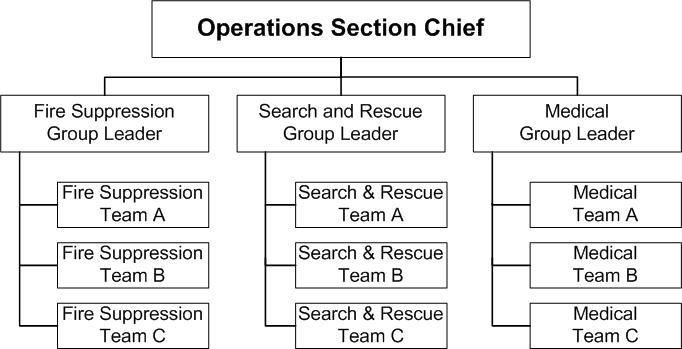
7.2.10 NERT operations section structure, showing the Operations Section Chief at the top and the three Group Leaders underneath
NERT ORGANIZATION (CONTINUED)
7.2.11 DEALING WITH THE MEDIA
NERT members should refer any media inquiries to the NERT IC/TL. The IC/TL should then refer the media inquiries to the Public Information Officer of the SFFD.
If the Public Information Officer of the sponsoring organization refers media to the NERT IC/TL or otherwise authorizes them to speak with the media:
- Wait to do so until it will not inhibit or delay the team’s ability to do the greatest good for the greatest number in the shortest amount of time
- Establish an area for briefing the media if necessary
- Be careful about the information he or she releases, making sure it is both accurate and approved for release by the Battalion Chief, while also keeping in mind survivors’ right to privacy
- Not feel compelled to answer every question asked
7.2.12 NIMS COMPLIANCE
The Incident Command System is part of the National Incident Management System (NIMS). NIMS provides a consistent, comprehensive approach to incident management. It applies at all jurisdictional levels and across all emergency management functions and types of incidents.
NIMS was established so that first responders, including NERT members, from different jurisdictions and disciplines can work together to respond to disasters and emergencies.
- While not required to be a NERT responder, to meet NIMS standards, NERT members must complete the IS-100.a (Introduction to Incident Command System) and IS-700.b (Introduction to National Incident Management System [NIMS]) courses.
- The courses are available online from FEMA at http://training.fema.gov/IS/NIMS.asp.
7.3 NERT Mobilization
The following steps describe how NERTs mobilize when an incident occurs. Immediately following the incident, NERT members take care of themselves, their families, their homes, and their neighbors.
- The NERT volunteers self-activate after a disaster has been declared. NERT members proceed to the predesignated staging area with their disaster supplies. Along the way, they make damage assessments that would be helpful for the NERT IC/TFL’s decision-making.
- The first NERT member at the staging area becomes the initial IC/TFL for the response. As other NERT members arrive, the NERT IC/TFL may pass leadership to someone else. The NERT IC/TFL establishes operations to ensure effective communication, to maintain span of control, to maintain accountability, and to do the greatest good for the greatest number without placing NERT responders in harm’s way.
NERT MOBILIZATION (CONTINUED)
- One of the NERT IC/TFL’s first decisions will be to locate the team’s Neighborhood Command Post (NCP). The staging area is the default location, however, if another location would be safer or otherwise better, the NCP should be set up there.
- As intelligence is collected and assessed, the IC/TFL must prioritize actions and work with the Section Chiefs or leaders. The Planning Section Chief can make many decisions about directing field team assignments with permission and guidelines from the IC/TFL. The NERT organization is flexible and evolves based on new information.
Following an incident, information — and, therefore, priorities — may be changing rapidly. Communication between the NCP and field response teams ensures that NERTs do not overextend their resources or supplies.
7.3.1 RESCUER SAFETY
Effective emergency scene management requires the formulation and communication of strategic goals and tactical objectives to do the most good for the greatest number while maintaining the safety of rescue personnel.
Rescuer safety is paramount. First ask “Is it safe for the NERT responders to attempt the assignment?” Review size up procedures as part of the team Safety briefing.
7.3.2 NERT TASKS BASED ON DAMAGE LEVEL
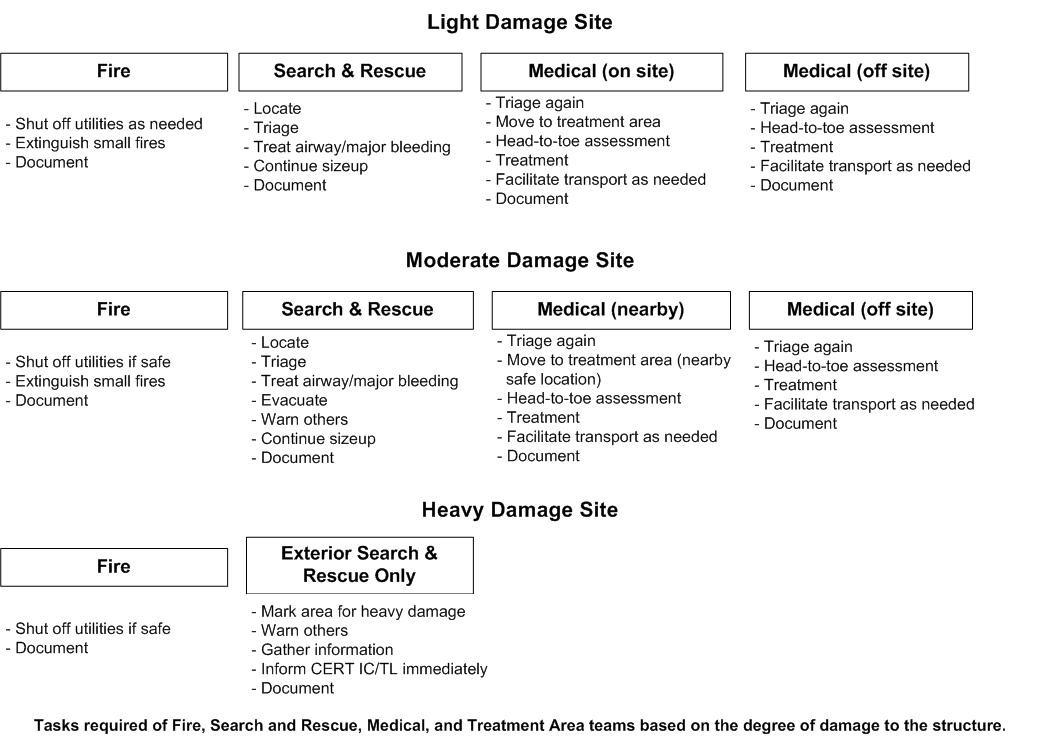
7.4 Documentation
It is extremely important to document information about the disaster situation and resource status. Efficient flow of information makes it possible for resources to be deployed effectively and for professionals to be informed. Write it down! So that:
- The NERT IC/TFL will know what is happening throughout the incident.
- The NERT IC/TFL will have written information to pass on to the SFFD.
- The NERT will be able to show volunteer hours it provided for Disaster Declaration reimbursement to San Francisco.
- Liability exposure will be documented.
- Communication will be improved between the functional areas and between shifts:
Under the NERT structure, each level of organization has documentation responsibilities:
- Section Chiefs are responsible for providing the NCP ongoing information about damage assessment, group status, and needs.
The Command Post is responsible for documenting the situation status of:
- Incident locations and Identified hazards
- Access routes
- Support locations: staging area, medical treatment area
Every entity such as a functional team or staging location must record everything. A scribe should be assigned to these leaders as necessary.
7.4.1 DOCUMENTATION FORMS
These are the forms that can be used to facilitate documentation and information flow. These forms are functionally consistent with Incident Command System (ICS) forms.
- Damage Assessment
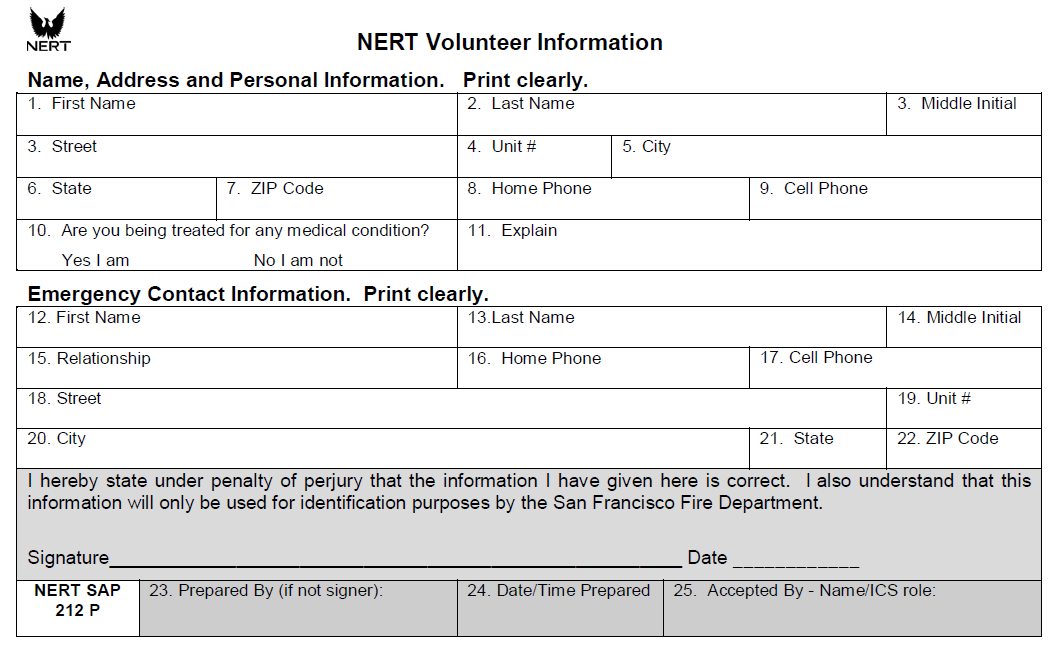
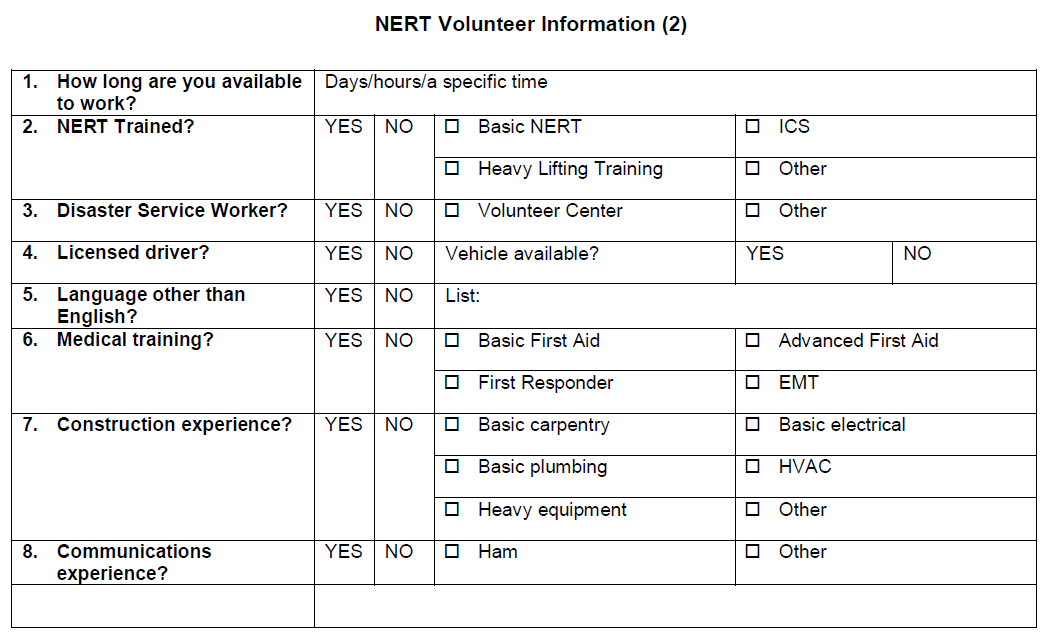
- Volunteer Information Card
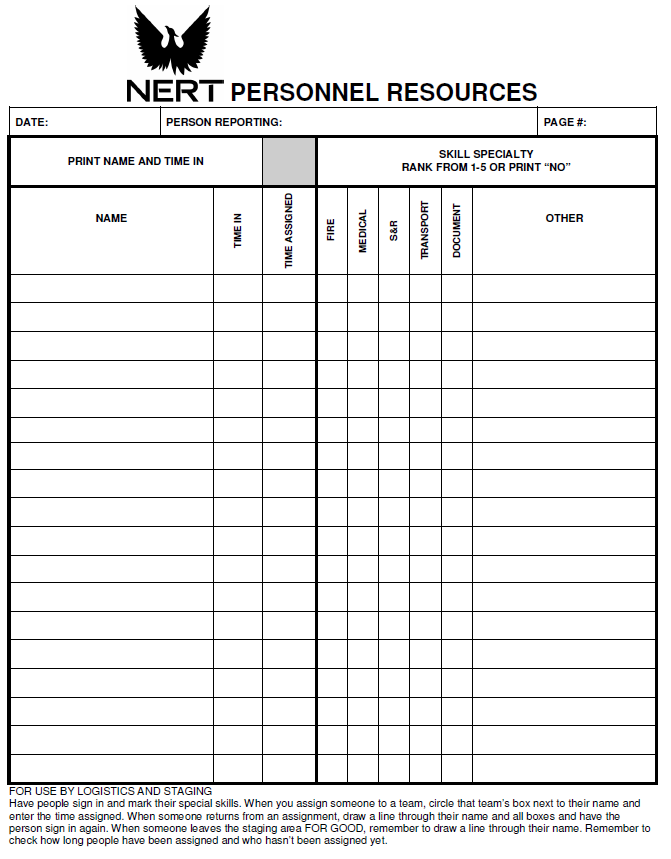
- Personnel Resources (Sign-In)
- Incident Status Record
- Incident Report Form
- Unit Log (ICS214)
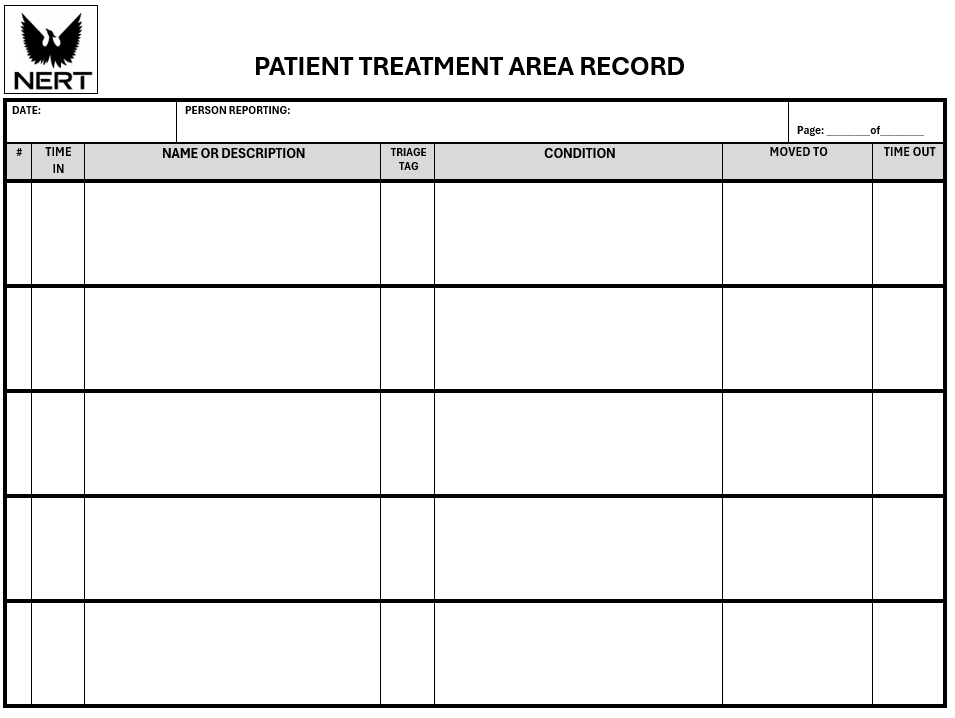
- Patient Treatment Area Record
- Communications Log
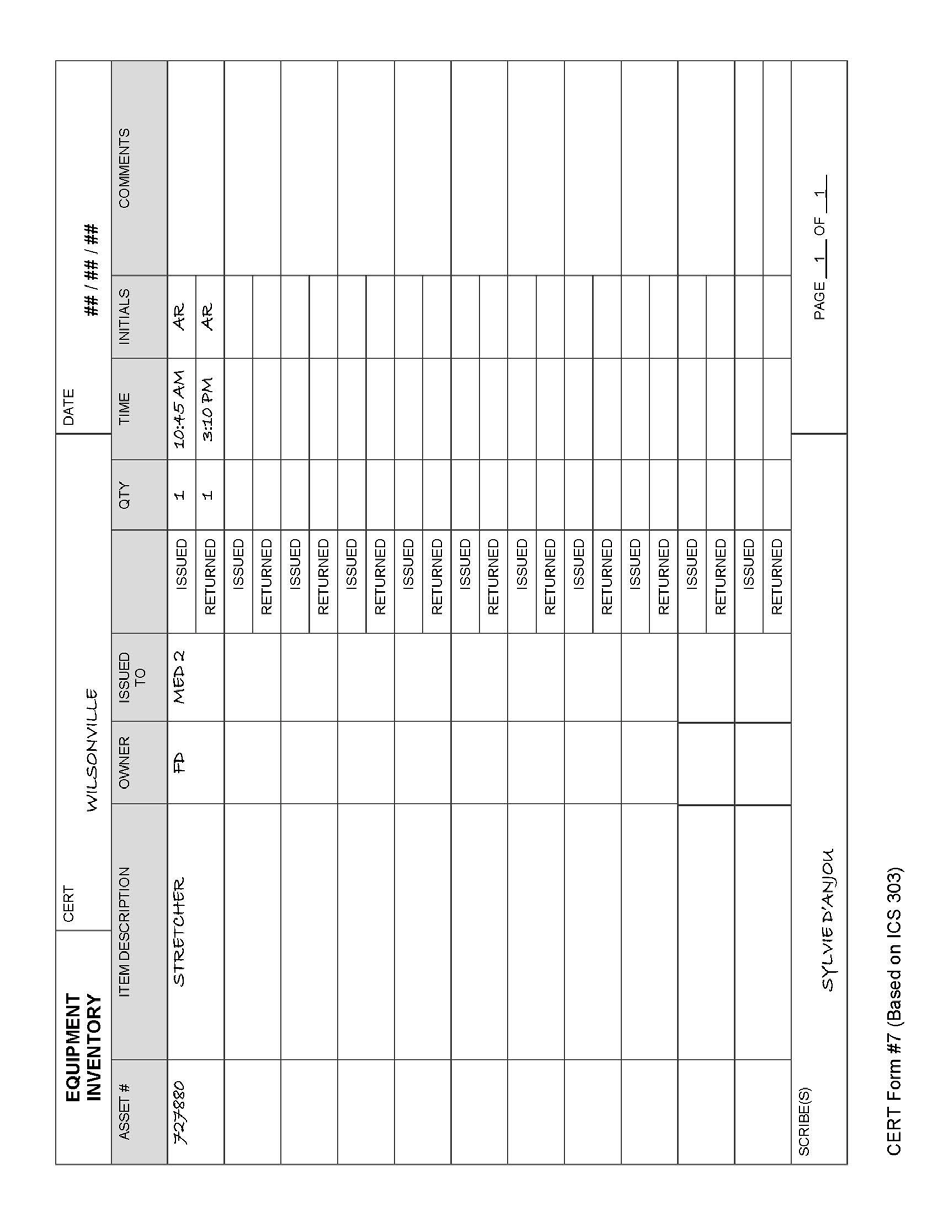
- Equipment Inventory
- General Message (ICS213)
Remember that scribes can produce useful, high-quality documentation without using the forms as long as they take detailed notes of all activities.
| FORMS USED FOR RESPONSE DOCUMENTATION | |
| FORM | PURPOSE |
| Damage Assessment Form | Completed by NERT members as they travel through the area to the staging area, then given to the NERT Planning section. It provides a summary of overall hazards in selected areas and is essential for NERTs to make an action plan |
| Volunteer Information Card | Completed by every NERT member and used to sign in at the Logistics section |
| Personnel Resources (Sign-In) |
Used by the Logistics section to track personnel availability and to provide information about: - Who is on site - When they arrived - Where they were assigned |
| Incident Report Form (Card) | Used by the Planning section to record essential information about an incident from the Incident Status Record Form and provide it to the Operations section so that a Field Team can be briefed and dispatched. |
| Incident Status Record | A master status tracking sheet used in the Planning section to keep a record of all incident information that comes into the NCP. The scribe assigns the incident a number when it is recorded on the sheet. |
|
Unit Log (ICS 214 form) |
This is used to record/journal major times and details in your response. Used by every NERT member who is a leader: - IC/TL - NCP Section leaders - Field team leaders |
| Patient Treatment Area Record |
Completed by medical treatment area personnel to record patients entering the treatment area, their condition, and their status |
| Communications Log | Completed by the radio operator; used to log incoming and outgoing transmissions |
| Equipment Inventory | Used in the Logistics section to check in NERT managed equipment and supplies |
| Message Form(ICS 213 form) |
Used for sending messages between command levels and groups; messages should be clear and concise. Examples include: - Additional resources requested/required - Special information - Information that the radio operator should transmit to Battalion |
DOCUMENTATION (CONTINUED)
7.4.2 DOCUMENTATION FLOW
NERTs use the standard documents within the NCP. Remind participants that, even if the forms are not used, this should give them an idea of the preferred information that needs to be collected and communicated between groups.
- The Damage Assessment Form is completed by NERT members as they travel through the area to the staging area. The form is then given to the Planning Section. The form provides a summary of overall hazards in selected areas. The information is used for recording, prioritizing and formulating activities.
- The Operations Section leader assembles teams and makes assignments based on the damage assessment information provided to them from the Planning Section on the Incident Report Form. The Operations section provides a briefing to the Field Team Leader from this form. This is a tool for recording the activities of the field teams when they return and should be returned to the Planning section at that time.
- Logistics Section collects the Volunteer Information Card and signs in each volunteer using the Personnel Resources Form. Logistics will note where a NERT member is assigned on that form. Any available NERT member is assigned at Logistics until they receive another assignment.
7.4.3 ADDITIONAL DOCUMENTATION
Area maps, site maps, and building plans are also very useful for assisting and tracking response activities.
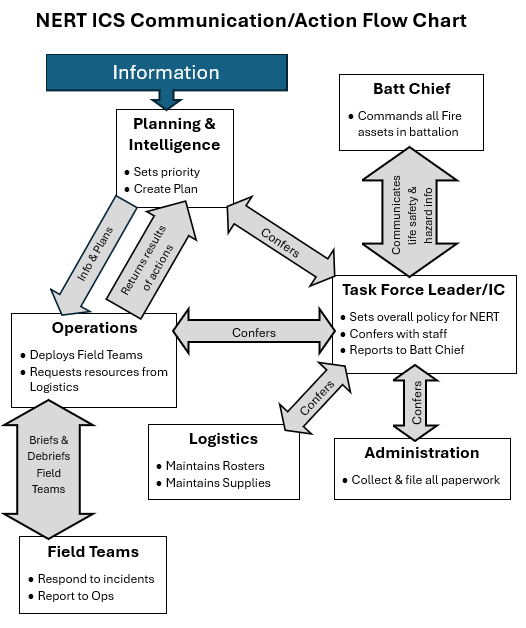
7.5 FORMS
NERT DAMAGE ASSESSMENT FORM
| Page: | Person Reporting: | NERT Task Force/Battalion: | ||||||||||
| Date & Time: | Person Receiving/ICS Position: | Block: | ||||||||||
|
Fire Burning, Out, None |
Hazard Gas, Water, Electrical, HazMat, None |
Damage Heavy, Medium, Light, None |
Street Open, Blocked |
|||||||||
| Incident # | Address | Fire | Hazard | Damage | Street | Other | ||||||
| Injured | Trapped | Need Shelter | Dead | Not Home | ||||||||
| Actions Taken, Resources Needed, Resources Available | ||||||||||||
| Incident # | Address | Fire | Hazard | Damage | Street | Other | ||||||
| Injured | Trapped |
Need Shelter |
Dead | Not Home | ||||||||
| Actions Taken, Resources Needed, Resources Available | ||||||||||||
| Incident # | Address | Fire | Hazard | Damage | Street | Other | ||||||
| Injured | Trapped |
Need Shelter |
Dead | Not Home | ||||||||
| Actions Taken, Resources Needed, Resources Available | ||||||||||||
| Incident # | Address | Fire | Hazard | Damage | Street | Other | ||||||
| Injured | Trapped |
Need Shelter |
Dead | Not Home | ||||||||
| Actions Taken, Resources Needed, Resources Available | ||||||||||||
| PLEASE PRINT CLEARLY! | ||||||||||||
NERT VOLUNTEER INFORMATION CARD
NERT INCIDENT REPORT FORM
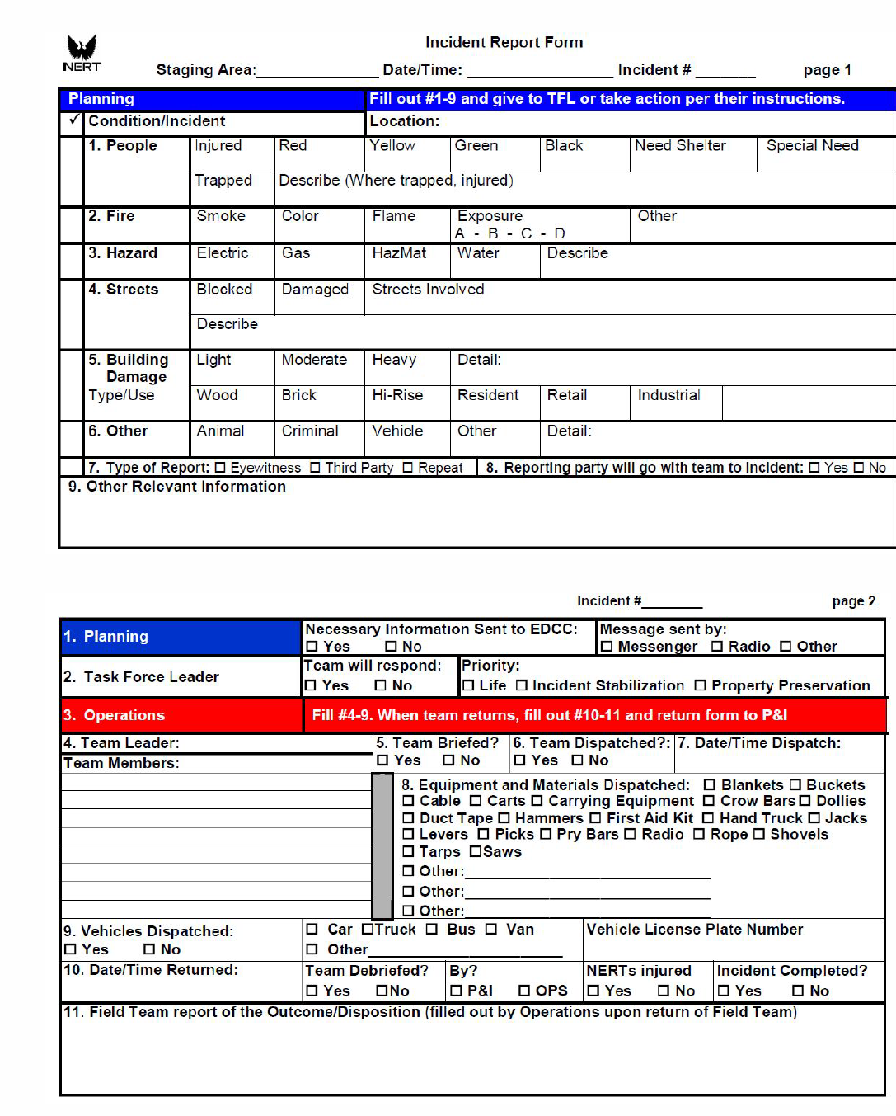
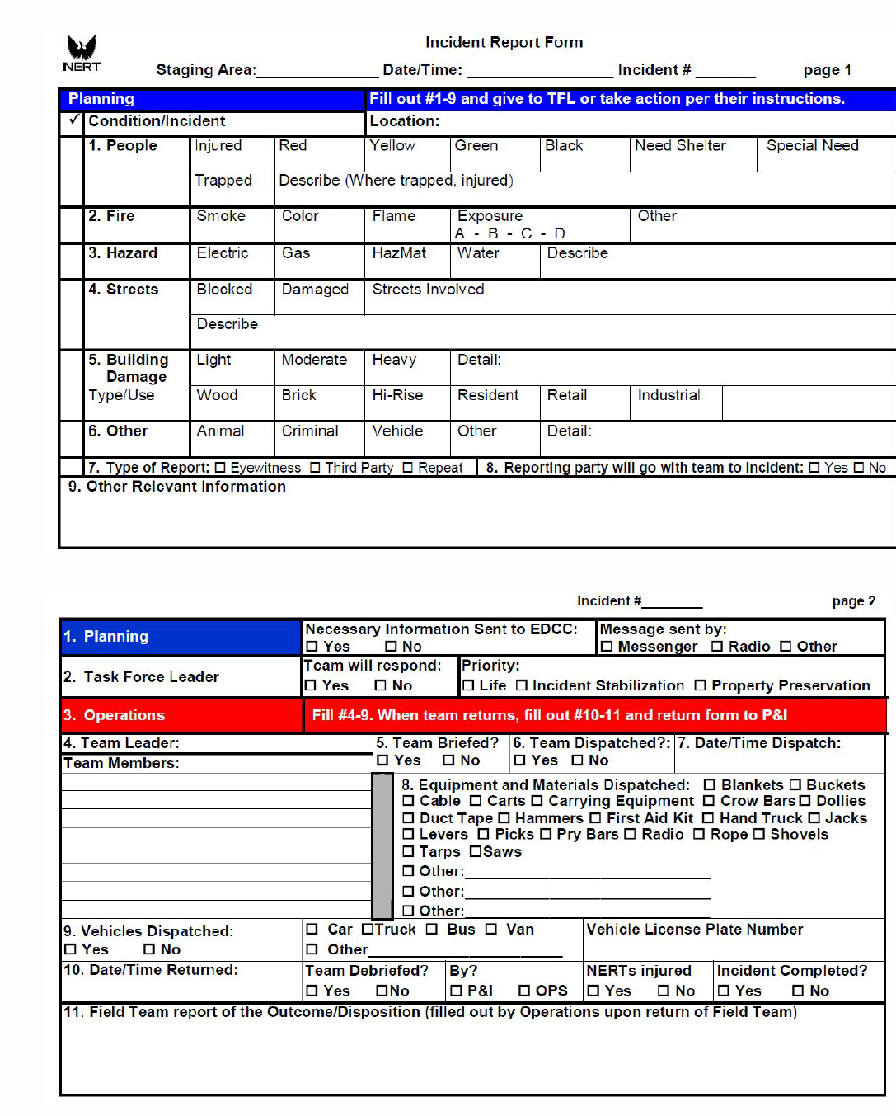
PLANNING Section fills out the front of the card with relevant information from the reported incident. They pass the card to OPERATIONS, who briefs and sends a Field Team. OPERATIONS fills out the back side of the card after the Field Team returns and provides an update. The form is returned to PLANNING.
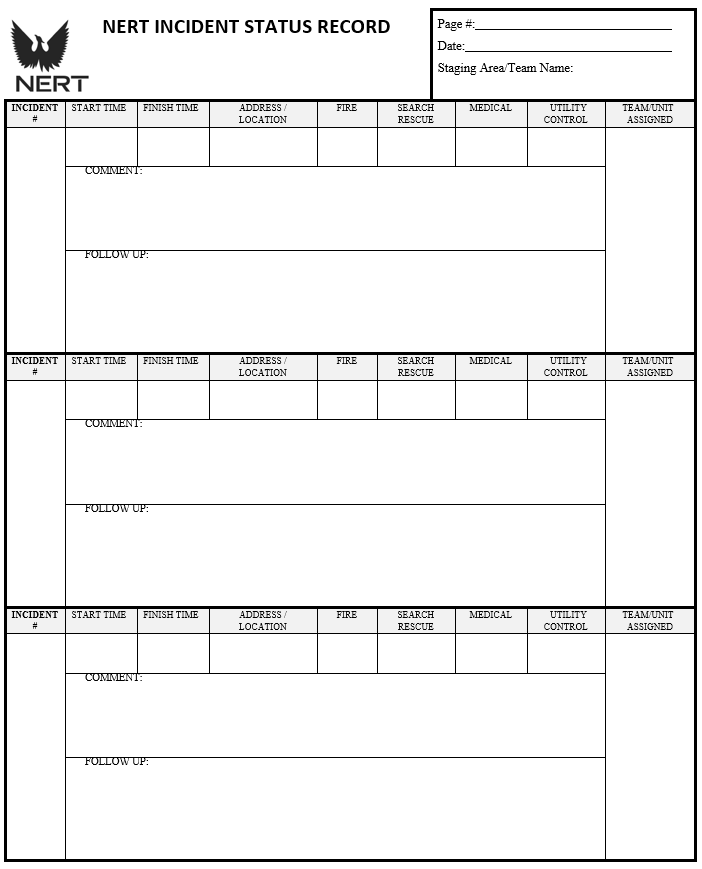
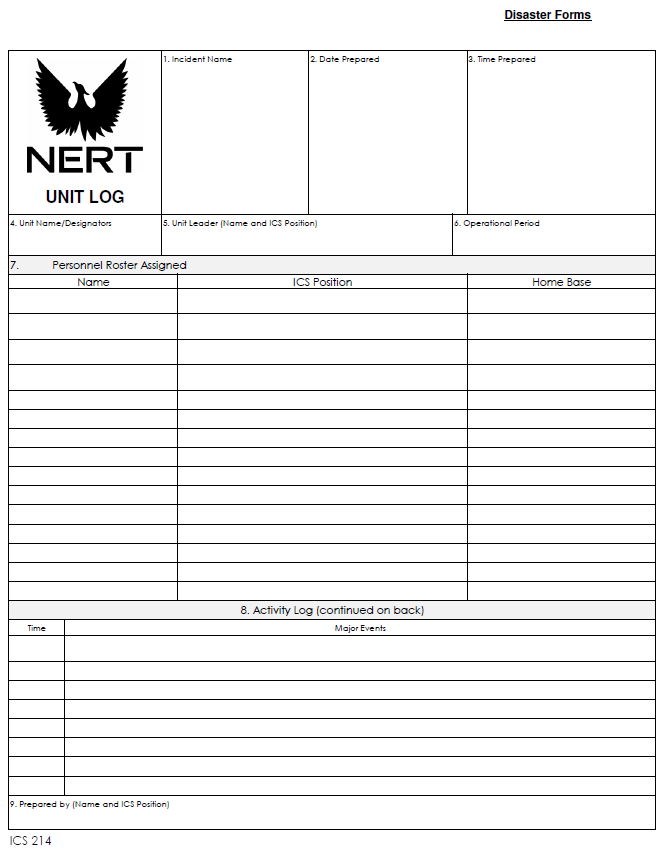
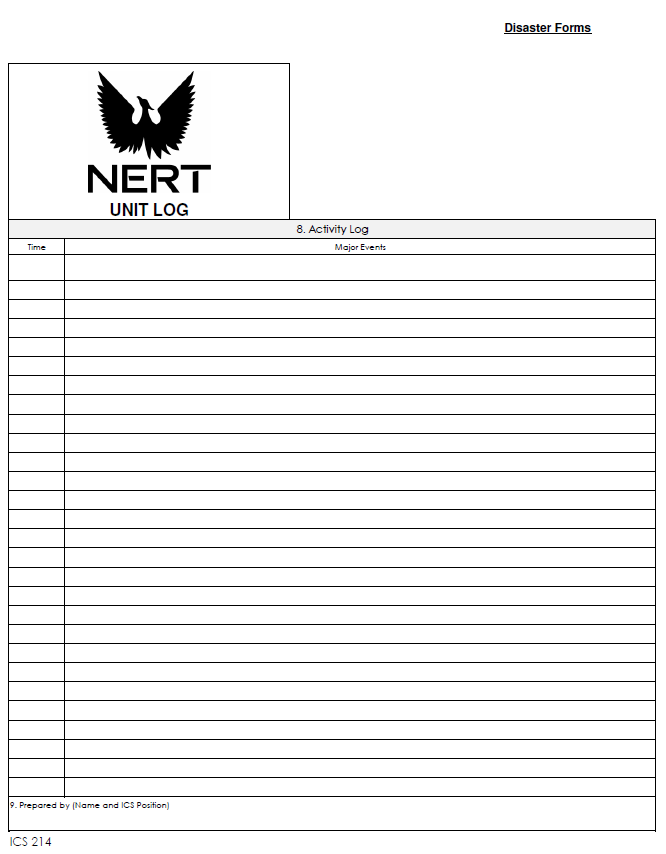
PATIENT TREATMENT AREA RECORD
COMMUNICATIONS LOG
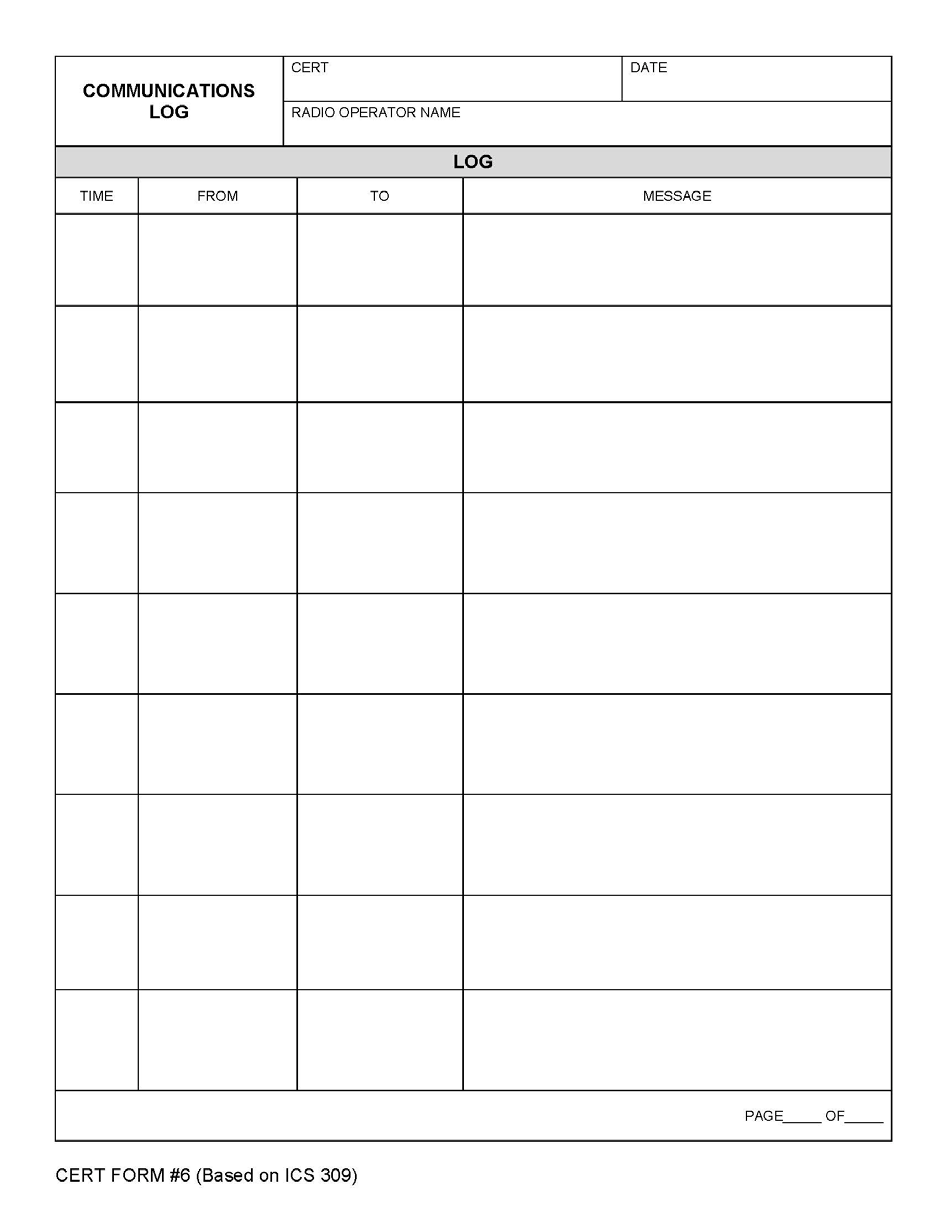
COMMUNICATIONS section uses this form to track messages sent and received. It is helpful to assign the messages a message number.
EQUIPMENT INVENTORY
MESSAGE FORM (ICS213)
|
TO: FROM (Team Name/ICS position & Staging Site): SUBJECT:_____________________________________________________________ DATE: TIME: MESSAGE NUMBER:__________________________ |
|||
| MESSAGE TEXT: |
What – is the incident you are reporting? ie. People trapped, fire burning, road blocked Where – did the incident happen? ie. 822 Connecticut near 20th Street, intersection of Market & Geary When – did the incident happen? ie. At 12:15 p.m., reported at 2:05 p.m. How – is the Incident Commander responding? If yes, describe briefly. If no, say no response. |
||
| Examples: assignment completed, additional resources needed, unable to complete, special information/status update. | |||
| REPLY: | DATE:__________ TIME:__________ ICS POSITION:_________________ | ||
Home ActivityPurpose: This activity will give you an opportunity to relate the ICS functions to specific situations.Instructions: Review the list of activities and indicate which ICS function would cover each activity. Some activities may involve more than one function to be completed. Use the following key to fill in the blank column: TFL= Team Leader (Incident Commander)Ops = Operations P = PlanningLog = LogisticsHome ActivityPurpose: This activity will give you an opportunity to relate the ICS functions to specific situations.Instructions: Review the list of activities and indicate which ICS function would cover each activity. Some activities may involve more than one function to be completed. Use the following key to fill in the blank column: TFL= Team Leader (Incident Commander)Ops = Operations P = PlanningLog = Logistics
| 1. It’s dark, all the lights are out, you need additional flashlights to continue your response. | |
|---|---|
| 2. The designated first aid site has a downed power line. | |
| 3. A neighbor reports the smell of gas in his house, but he cannot shut off the gas at the meter. | |
| 4. The batteries for the portable radio are dead. | |
| 5. The fire department wants to know the overall status of your neighborhood. | |
| 6. Several of your neighbors have minor injuries and need first aid. | |
| 7. Fire from another neighborhood is moving toward your neighborhood. | |
| 8. There is a pit bull-type dog seen wandering near the first aid station. | |
| 9. A news crew has arrived with a camera to film your activities. | |
| 10. Two hysterical neighbors are demanding help. One cannot find her adolescent child who was playing outside when the disaster struck. The other wants help moving a bookcase off of his wife. He says she’s bleeding from a head wound | |
| 11. It’s starting to rain. Your command post and the first aid area are not under shelter. | |
| 12. Too many people are coming to the Incident Commander to ask questions. The TFL asks for someone to act as a “gatekeeper.” | |
| 13. The TFL is very tired and is going to hand over responsibilities to someone else. He or she wants a report on the status of the neighborhood before doing so. | |
| 14. Many neighborhood residents have come to volunteer their help. | |
| 15. Reports have come in of damage and injuries in the next block. Teams must be assigned to assess the situation. | |
| 16. A professional responder has arrived at the scene and would like a briefing on situation status. |
Chapter 6 Summary
The key points from this chapter:
- The Incident Command System (ICS) is the system used by emergency response agencies and NERT to manage emergency operations.
- ICS is a flexible means of management for personnel, facilities, equipment, and communication. It can be expanded as necessary.
- The key question that NERT Incident Commanders/Task Force Leaders must always ask is: “Is it safe for NERT members to attempt the response activity?”
- It is vital to document and communicate information about situation and resource status to all NERT levels.
- The command post must document the situation status so that the overall disaster situation can be tracked and reported to emergency response agencies.
- Sections, Groups, and Teams must provide the Neighborhood Command Post (NCP) with ongoing information about damage assessment, incident status, and ongoing needs.